
Activity 54.
Use known geometric formulas and the net signed area interpretation of the definite integral to evaluate each of the definite integrals below.
(a)
\(\int_0^1 3x \, dx\)
Hint.
Sketch the region bounded by \(y = 3x\) and the \(x\)-axis on \([0,1]\text{.}\)
Answer.
\(\int_0^1 3x \, dx = \frac{3}{2}\text{.}\)
Solution.
Because \(y = 3x\) and the \(x\)-axis bound a triangle with base of length 1 and height \(3\) on the interval \([0,1]\text{,}\) it follows that
\begin{equation*}
\int_0^1 3x \, dx = \frac{1}{2} \cdot 1 \cdot 3 = \frac{3}{2}\text{.}
\end{equation*}
(b)
\(\int_{-1}^4 (2-2x) \, dx\)
Hint.
Sketch the region bounded by \(y = 2-2x\) and the \(x\)-axis on \([-1,4]\text{.}\)
Answer.
\(\int_{-1}^4 (2-2x) \, dx = -5\text{.}\)
Solution.
For \(\int_{-1}^4 (2-2x) \, dx\text{,}\) we first sketch the region bounded by the function, as shown below.
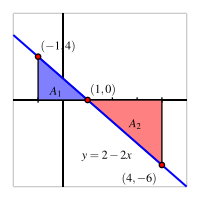
The line creates two triangles, one with area \(A_1 = \frac{1}{2} \cdot 2 \cdot 4 = 4\) and the other with area \(A_2 = \frac{1}{2} \cdot 3 \cdot 6 = 9\text{.}\) Since the latter area corresponds to a region below the \(x\)-axis, we associate a negative sign to it, and hence find that
\begin{equation*}
\int_{-1}^4 (2-2x) \, dx = A_1 - A_2 = 4 - 9 = -5\text{.}
\end{equation*}
(c)
\(\int_{-1}^0 -\sqrt{1-x^2} \, dx\)
Hint.
Observe that \(y = -\sqrt{1-x^2}\) is the bottom quarter the circle whose equation is \(x^2 + y^2 = 1\text{.}\)
Answer.
\(\int_{-1}^0 -\sqrt{1-x^2} \, dx = -\frac{\pi}{4}\text{.}\)
Solution.
For \(\int_{-1}^0 -\sqrt{1-x^2} \, dx\text{,}\) we simply observe that this function is the bottom quarter of a circle of radius 1, and thus the bounded region is a quarter disk of radius 1, thus having an area of \(\frac{\pi}{4}\text{.}\) Therefore,
\begin{equation*}
\int_{-1}^0 -\sqrt{1-x^2} \, dx = -\frac{\pi}{4}\text{.}
\end{equation*}
(d)
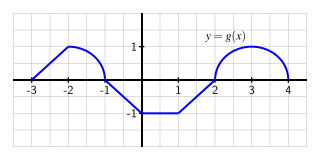
\(\int_{-3}^4 g(x) \, dx\text{,}\) where \(g\) is the function pictured in Figure 194. Assume that each portion of \(g\) is either part of a line or part of a circle.
Hint.
Use known formulas for the area of a triangle, square, or circle appropriately.
Answer.
\(\int_{-3}^4 g(x) \, dx = \frac{3\pi}{4} - \frac{3}{2}\text{.}\)
Solution.
Finally, for \(\int_{-3}^4 g(x) \, dx\text{,}\) where \(g\) is the function pictured in the problem, we consider the function on seven consecutive subintervals of length 1. Observe that on \([-3,-2]\text{,}\) the bounded area is \(\frac{1}{2}\text{.}\) On \([-2,-1]\text{,}\) the area is \(\frac{1}{4} \pi\text{.}\) Similarly, on the next five subintervals of length 1, the areas bounded are respectively \(\frac{1}{2}\text{,}\) \(1\text{,}\) \(\frac{1}{2}\text{,}\) \(\frac{1}{4} \pi\text{,}\) and \(\frac{1}{4} \pi\text{.}\) Thus, the value of the integral is
\begin{equation*}
\int_{-3}^4 g(x) \, dx = \frac{1}{2} + \frac{\pi}{4} - \frac{1}{2} - 1 - \frac{1}{2} + \frac{\pi}{4} + \frac{\pi}{4} = \frac{3\pi}{4} - \frac{3}{2}\text{,}
\end{equation*}
which is approximately 0.8562.

