
Activity 17.
Consider a function that is piecewise-defined according to the formula
\begin{equation*}
f(x) = \begin{cases}3(x+2)+2 \amp \text{ for }-3 \lt x \lt -2 \\
\frac{2}{3}(x+2)+1 \amp \text{ for }-2 \le x \lt 1 \\
1 \amp \text{ for } x = 1 \\
4-x \amp \text{ for } 1 \lt x \lt 2 \\
2 \amp \text{ for }2 \lt x
\end{cases}
\end{equation*}
Use the given formula to answer the following questions.
(a)
For each of the values \(a = -2, -1, 0, 1, 2\text{,}\) compute \(f(a)\text{.}\)
Hint.
Find the interval in which \(a\) lies and evaluate the function there.
Answer.
\(f(-2) = 1\text{;}\) \(f(-1)=\frac{5}{3}\text{;}\) \(f(0) = \frac{7}{3}\text{;}\) \(f(1) = 1\text{;}\) \(f(2)\) is undefined.
Solution.
\(f(-2) = \frac{2}{3}(-2+2) + 1 = 1\text{;}\) \(f(-1)=\frac{2}{3}+1=\frac{5}{3}\text{;}\) \(f(0) = \frac{4}{3}+1 = \frac{7}{3}\text{;}\) \(f(1) = 1\text{;}\) \(f(2)\) is undefined.
(b)
For each of the values \(a = -2, -1, 0, 1, 2\text{,}\) determine \(\displaystyle \lim_{x \to a^-} f(x)\text{.}\)
Hint.
Remember that for \(\lim_{x \to a^-} f(x)\text{,}\) we only consider values of \(x\) such that \(x \lt a\text{.}\) Find the right formula to use in the piecewise definition for \(f\) to fit the values you are considering.
Answer.
\begin{equation*}
\lim_{x \to -2^-} f(x) = 2
\end{equation*}
\begin{equation*}
\lim_{x \to -1^-} f(x) = \frac{5}{3}
\end{equation*}
\begin{equation*}
\lim_{x \to 0^-} f(x) = \frac{7}{3}
\end{equation*}
\begin{equation*}
\lim_{x \to 1^-} f(x) = 3
\end{equation*}
\begin{equation*}
\lim_{x \to 2^-} f(x) = 2
\end{equation*}
Solution.
\begin{equation*}
\lim_{x \to -2^-} f(x) = \lim_{x \to -2^-} 3(x+2)+2 = 2
\end{equation*}
\begin{equation*}
\lim_{x \to -1^-} f(x) = \lim_{x \to -1^-} \frac{2}{3}(x+2)+1 = \frac{5}{3}
\end{equation*}
\begin{equation*}
\lim_{x \to 0^-} f(x) = \frac{7}{3}
\end{equation*}
\begin{equation*}
\lim_{x \to 1^-} f(x) = \lim_{x \to 1^-} \frac{2}{3}(x+2)+1 = 3
\end{equation*}
\begin{equation*}
\lim_{x \to 2^-} f(x) = \lim_{x \to 2^-} 4-x = 2
\end{equation*}
(c)
For each of the values \(a = -2, -1, 0, 1, 2\text{,}\) determine \(\displaystyle \lim_{x \to a} f(x)\text{.}\) If the limit fails to exist, explain why by discussing the left- and right-hand limits at the relevant \(a\)-value.
Hint.
Use your work in (b) and compare left- and right-hand limits.
Answer.
\(\lim_{x \to -2} f(x)\) does not exist. The values of the limits as \(x \to a\) for \(a = -1, 0, 1, 2\) are \(\frac{5}{3}, \frac{7}{3}, 3, 2\text{.}\)
Solution.
\(\lim_{x \to -2} f(x)\) does not exists because the left-hand limit is \(2\) while the right-hand limit is \(1\text{.}\) All of the other requested limits exist, as left- and right-hand limits exist and are equal in each case. The respective values of the limits as \(x \to a\) for \(a = -1, 0, 1, 2\) are \(\frac{5}{3}, \frac{7}{3}, 3, 2\text{.}\)
(d)
For which values of \(a\) is the following statement true?
\begin{equation*}
\lim_{x \to a} f(x) \ne f(a)
\end{equation*}
Hint.
Use your work in (a) and (c).
Answer.
\(a = -2\text{,}\) \(a = 1\text{,}\) and \(a = 2\text{.}\)
Solution.
For \(a = -2\text{,}\) \(a = 1\text{,}\) and \(a = 2\text{,}\) \(\lim_{x \to a} f(x) \ne f(a)\text{.}\) At \(a = -2\text{,}\) the limit fails to exist, but \(f(-2) = 1\text{.}\) At \(a = 1\text{,}\) the limit is \(3\text{,}\) but \(f(1)=1\text{.}\) At \(a = 2\text{,}\) the limit is 2, but \(f(2)\) is undefined.
(e)
On the axes provided, sketch an accurate, labeled graph of \(y = f(x)\text{.}\) Be sure to carefully use open circles (○) and filled circles (●) to represent key points on the graph, as dictated by the piecewise formula.
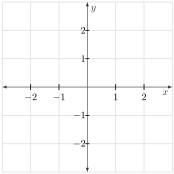
Graph the piecewise-defined function described here.
Hint.
Note that \(f\) is piecewise linear.
Answer.
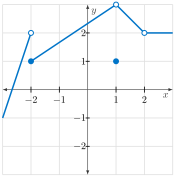
The graph of the piecewise-defined function described in this activity.

