
Activity 8.
On a grid in Figure 148, sketch the graph of \(f(x)=x^{2}-4\) over \([-3,3]\text{.}\) On another grid in Figure 148, sketch the graph of \(g(x) = |x^{2}-4|\) over \([-3,3]\text{.}\)
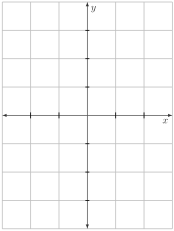
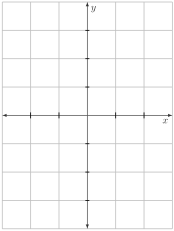
(a)
Use the definition of the derivative at a point to calculate the value of \(g'(0)\text{,}\) if it exists. Does your answer make sense? Plot the point \((0,g'(0))\) on the graph of \(g(x)\) above.
Hint.
Use the definition with \(a=0\text{.}\)
Answer.
\(g'(0)=0\)
Solution.
\begin{align*}
g'(0) = \mathstrut \amp \lim_{h \rightarrow 0}\frac{g(0+h)-g(0)}{h} \\
= \mathstrut \amp \lim_{h \rightarrow 0} \frac{g(h)-g(0)}{h} \\
= \mathstrut \amp \lim_{h \rightarrow 0} \frac{|h^2-4|-|0^2-4|}{h} \\
= \mathstrut \amp \lim_{h \rightarrow 0} \frac{-(h^2-4)-4}{h} \\
= \mathstrut \amp \lim_{h \rightarrow 0} \frac{-h^2}{h} \\
= \mathstrut \amp \lim_{h \rightarrow 0} -h \\
= \mathstrut \amp 0
\end{align*}
This follows since \(h^2-4 < 0\) for \(h\) near 0. So \((0,g'(0))=(0,0)\text{.}\)
(b)
Calculate, if it exists, the value of \(g'(1)\text{.}\) Plot the point \((1,g'(1))\) on the graph of \(g(x)\text{.}\)
Hint.
Use the definition with \(a=1\text{.}\)
Answer.
\(g'(1)=-2\)
Solution.
\begin{align*}
g'(1) = \mathstrut \amp \lim_{h \rightarrow 0}\frac{g(1+h)-g(1)}{h} \\
= \mathstrut \amp \lim_{h \rightarrow 0} \frac{|(1+h)^2-4|-|1^2-4|}{h} \\
= \mathstrut \amp \lim_{h \rightarrow 0} \frac{-((1+h)^2-4)-3}{h} \\
= \mathstrut \amp \lim_{h \rightarrow 0} \frac{-2h-h^2}{h} \\
= \mathstrut \amp \lim_{h \rightarrow 0} -2-h \\
= \mathstrut \amp -2
\end{align*}
This follows since \((1+h)^2-4 < 0\) for \(h\) near 0. So \((1,g'(1))=(1,-2)\text{.}\)
(c)
Calculate, if it exists, the value of \(g'(2)\text{.}\) Again, illustrate your answer on the graph of \(g(x)\text{.}\)
Note: \(\displaystyle \lim_{h \rightarrow 0}\frac{g(2+h)-g(2)}{h}\) is a two-sided limit. We investigate the value from each side.
\(\displaystyle \lim_{h \rightarrow 0^-}\frac{g(2+h)-g(2)}{h}=\)
\(\displaystyle \lim_{h \rightarrow 0^+}\frac{g(2+h)-g(2)}{h}=\)
Hint.
The absolute value function behaves differently for \(h\) positive and \(h\) negative.
Answer.
\(g'(2)\) does not exist
Solution.
\begin{align*}
g'(2) = \mathstrut \amp \lim_{h \rightarrow 0^-}\frac{g(2+h)-g(2)}{h} \\
= \mathstrut \amp \lim_{h \rightarrow 0^-} \frac{|(2+h)^2-4|-|2^2-4|}{h} \\
= \mathstrut \amp \lim_{h \rightarrow 0^-} \frac{-(4+4h+h^2-4)}{h} \\
= \mathstrut \amp \lim_{h \rightarrow 0^-} \frac{-4h-h^2}{h} \\
= \mathstrut \amp \lim_{h \rightarrow 0^-} -4-h \\
= \mathstrut \amp -4
\end{align*}
since \((2+h)^2 < 4\) for \(h < 0\text{.}\) But then we also have the following:
\begin{align*}
g'(2) = \mathstrut \amp \lim_{h \rightarrow 0^+}\frac{g(2+h)-g(2)}{h} \\
= \mathstrut \amp \lim_{h \rightarrow 0^+} \frac{|(2+h)^2-4|-|2^2-4|}{h} \\
= \mathstrut \amp \lim_{h \rightarrow 0^+} \frac{4+4h+h^2-4}{h} \\
= \mathstrut \amp \lim_{h \rightarrow 0^+} \frac{4h+h^2}{h} \\
= \mathstrut \amp \lim_{h \rightarrow 0^+} 4+h \\
= \mathstrut \amp 4
\end{align*}
since \((2+h)^2 > 4\) if \(h > 0\text{.}\) So \(g'(2)\) does not exist since the two one-sided limits differ.
(d)
Using symmetry, make a conjecture about the values of \(g'(-1)\) and \(g'(-2)\) and plot the corresponding ordered pairs on the graph of \(g(x)\text{.}\)
Answer.
\(g'(-1)=2\) and \(g'(-2)\) will not exist.
(e)
Using the applet found at https://www.geogebra.org/m/qwdxbtGF to check your answers to the above calculations. Be sure to also determine if your results make sense graphically.

