
Activity 43.
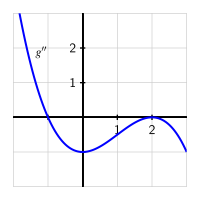
Suppose that \(g\) is a function whose second derivative, \(g''\text{,}\) is given by the graph in Figure 178.
(a)
Identify all \(x\)-values where \(g''(x) = 0\) or \(g''(x)\) is undefined. Then, construct a second derivative sign chart for \(g\) and hence state the intervals on which \(g\) is concave up, as well as the intervals on which \(g\) is concave down.
Hint.
Use the given graph to decide where \(g''\) is positive and negative.
Answer.
\(g\) is concave up for \(x \lt -1\text{,}\) concave down for \(-1 \lt x \lt 2\text{,}\) and concave down for \(x \gt 2\text{.}\)
Solution.
Note that \(g''(x) \gt 0\) for \(x \lt -1\text{,}\) \(g''(x) \lt 0\) for \(-1 \lt x \lt 2\text{,}\) and \(g''(x) \lt 0\) for \(x \gt 2\text{.}\) This tells us that \(g\) is concave up for \(x \lt -1\text{,}\) concave down for \(-1 \lt x \lt 2\text{,}\) and concave down for \(x \gt 2\text{.}\)
(b)
State the \(x\)-coordinates of all points of inflection of \(g\text{.}\)
Hint.
What must be true of \(g''(x)\) at a point of inflection?
Answer.
\(x = -1\) is an inflection point of \(g\text{.}\)
Solution.
Based on the given graph of \(g''\text{,}\) the only point at which \(g''\) changes sign is \(x = -1\text{,}\) and hence this is an inflection point of \(g\text{.}\)
(c)
Suppose you are given that \(g'(-1.67857351) = 0\text{.}\) Is there is a local maximum, local minimum, or neither (for the function \(g\)) at this critical number of \(g\text{,}\) or is it impossible to say? Why?
Hint.
What does the second derivative test say?
Answer.
\(g\) has a local minimum at \(x = -1.67857351\text{.}\)
Solution.
Given that \(g'(-1.67857351) = 0\text{,}\) we know that \(g\) has a horizontal tangent line at this critical number. In addition, from the given graph of \(g''\text{,}\) we see that \(g''( -1.67857351) \gt 0\) and observe that \(g\) is concave up at \(x\)-values near \(-1.67857351\text{.}\) By the second derivative test, \(g\) has a local minimum at \(x = -1.67857351\text{.}\)
(d)
Assuming that \(g''(x)\) is a polynomial (and that all important behavior of \(g''\) is seen in the graph above), what degree polynomial do you think \(g(x)\) is? Why?
Hint.
Can you guess a formula for \(g''(x)\) based on its graph?
Answer.
\(g\) is a degree 5 polynomial.
Solution.
From the given graph, since \(g''\) has a simple zero at \(x = -1\) and a repeated zero at \(x = 2\text{,}\) it appears that \(g''\) is a degree 3 polynomial. If so, then \(g'\) is a degree 4 polynomial, and \(g\) is a degree 5 polynomial.

