Handout Daily Prep 3.2 - Using Derivatives to Evaluate Limits

Section Overview

As we move on to Chapter 3, the theme of our work will focus on how we can apply the meaning of the derivative to solve important problems. Interestingly, although we use limits to define the derivative itself, it turns out that the derivative can be a useful tool in evaluating challenging limits of a certain type.
The topics discussed in this section are: Indeterminate forms of type β€œ0/0”. Local linearization and L’HΓ΄pital’s Rule. Infinite limits and limits at infinity. Asymptotes. Indeterminate forms of type β€œ\(\infty/\infty\)”. Indeterminate products of the form β€œ\(0 \cdot \infty\)”. Indeterminate powers of the form β€œ\(\infty^{0}\)”, β€œ\(1^{\infty}\)”, β€œ\(0^{0}\)”.

Section Basic learning objectives

These are the tasks you should be able to perform with reasonable fluency when you arrive at our next class meeting. Important new vocabulary words are indicated in italics.
  • State what it means to say that a limit has an indeterminate form and how such forms arise in the limit definition of the derivative.
  • State L’HΓ΄pital’s Rule.
  • Explain how L’HΓ΄pital’s Rule is used to calculate limits having an indeterminate form.
  • Explain what the expression \(\displaystyle \lim_{x \rightarrow \infty}f(x) = L\) means in plain English.
  • State the β€œ\(\infty\)” version of L’HΓ΄pital’s Rule.

Section To prepare for class

Complete all actions listed below. Respond to the questions highlighted with Submit.
  • Read motivating questions and the introduction to section 3.2 (up until Preview Activity 3.2.1).
  • Ask Copilot β€œWhat is meant by an indeterminant form of a limit?”
  • πŸ“ [Submit] Do Preview Activity 3.2.1.
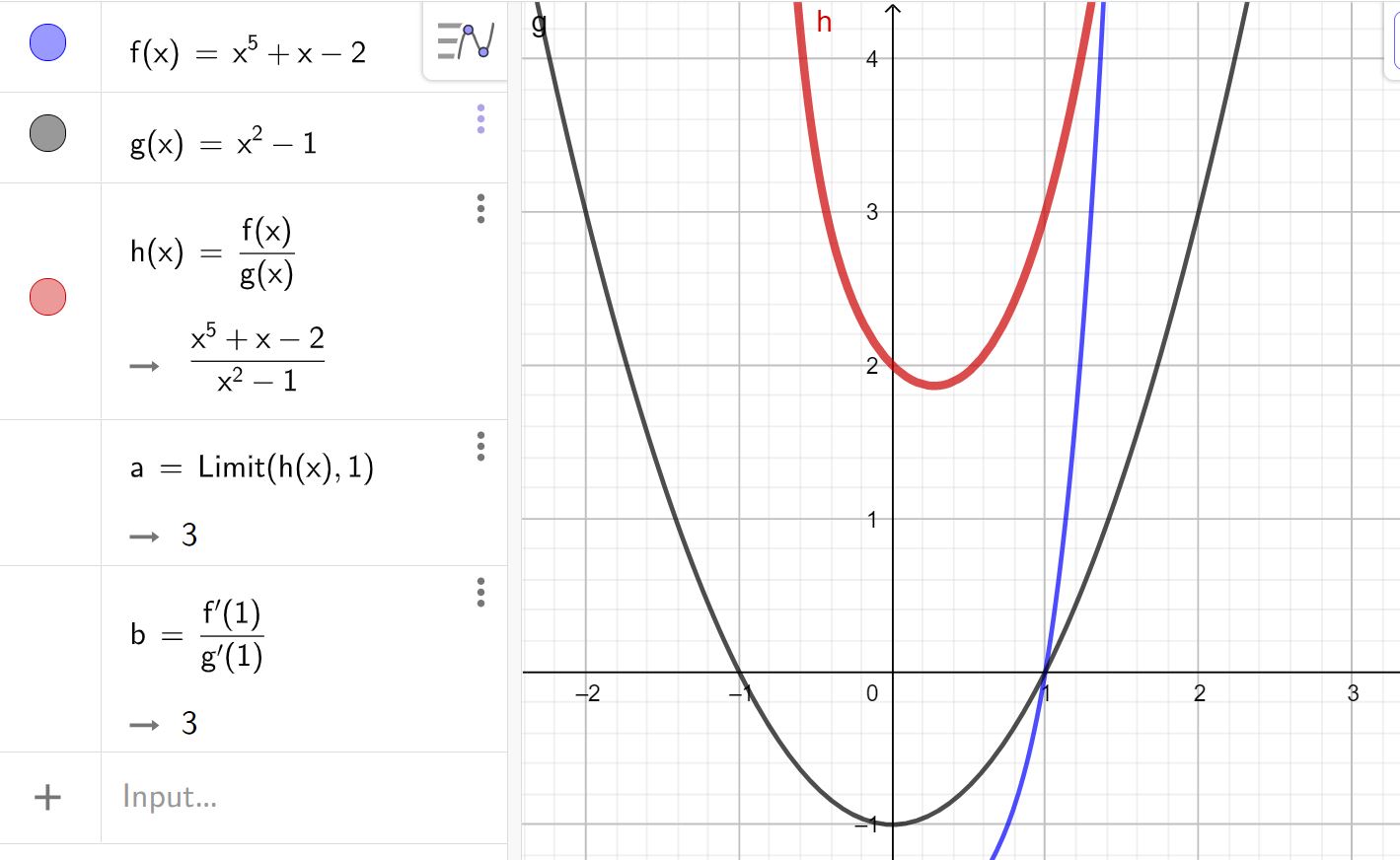
  • πŸ“ [Submit] Do the following construction (see FigureΒ 75) in GeoGebra. Note how the red graph of the quotient \(h(x)\) suggests that \(\displaystyle \lim_{x\rightarrow 1}\frac{x^{5}+x-2}{x^{2}-1}= 3\text{.}\) The value of \(b\) is what is computed via L’HΓ΄pital’s rule.
    A Geogebra display showing three functions and an expressions panel. In the expressions list on the left, f(x) equals x to the fifth plus x minus 2, g(x) equals x squared minus 1, and h(x) equals f(x) divided by g(x). On the right, three curves are plotted on the same coordinate grid. A black upward‑opening parabola represents g(x). A blue curve with steep growth near x equals 1 represents f(x). A red curve labeled h is drawn above the others and has a minimum near x equals 0. The x- and y-axes are shown with grid lines and tick marks.
    Figure 75. A GeoGebra construction used to investigate a limit that is indeterminant.
    Repeat this construction to analyze the limit found in Activity 3.2.2(a). That is, use \(f(x) = \ln(1+x)\text{,}\) \(g(x) = x\text{,}\) and investigate the limit of \(f(x)/g(x)\) as \(x \rightarrow 0\text{.}\) Submit screenshots as needed.
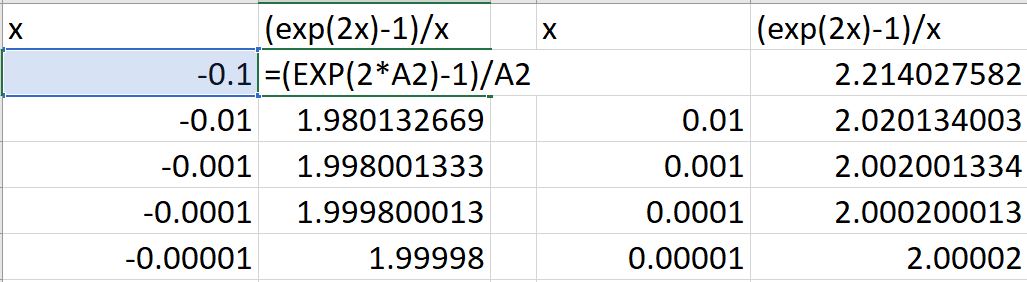
  • πŸ“ [Submit] Do form a table of values using a spreadsheet (Excel or Google Sheets) to form a hypothesis regarding the value of \(\displaystyle \lim_{x \rightarrow 0}\frac{e^{2x}-1}{x}\text{.}\) Values of \(x\) that are both negative and positive near zero should be used. Then, repeat the GeoGebra exploration above to see if the same value for the limit emerges. [Yes, you should get 2.] Sample output is shown in FigureΒ 76. Submit screenshots as needed.
    A spreadsheet-style table showing numerical values for the expression (exp(2x) minus 1) divided by x. The table is split into two sections. On the left, x takes negative values from minus 0.1 to minus 0.00001, with corresponding values approaching 2 from below. On the right, x takes positive values from 0.01 to 0.00001, with corresponding values approaching 2 from above. The values are arranged to show the behavior of the expression as x approaches zero.
    Figure 76. A spreadsheet can be used to form a hypothesis about the value of a limit.
  • Do the following problem.
    1. We attempt to evaluate the value of \(\displaystyle \lim_{x \rightarrow 0}\frac{e^{2x}-1}{x}\text{.}\) Define \(f(x) = e^{2x}-1\) (the numerator) and define \(g(x) = x\) (the denominator). Then \(\displaystyle \lim_{x \rightarrow 0}\frac{e^{2x}-1}{x}= \lim_{x \rightarrow 0}\frac{f(x)}{g(x)}.\)
      1. Does \(\displaystyle \lim_{x \rightarrow 0}\frac{f(x)}{g(x)}= \frac{f(0)}{g(0)}\text{?}\) Why or why not?
      2. Find the linear approximation \(L(x)\) to \(f(x)\) at \(a=0\text{.}\)
      3. Find the linear approximation \(M(x)\) to \(g(x)\) at \(a=0\text{.}\)
      4. Compute \(\displaystyle \lim_{x \rightarrow 0}\frac{L(x)}{M(x)}\text{.}\) How is this related to \(\displaystyle \frac{f'(0)}{g'(0)}\text{?}\)
      5. For \(x\) near 0,
        \begin{equation*} \frac{f(x)}{g(x)}= \frac{e^{2x}-1}{x}\approx \frac{2x}{x}= \frac{L(x)}{M(x)}= \frac{f'(0)}{g'(0)}. \end{equation*}
        As \(x \rightarrow 0\text{,}\) the approximation becomes better. This tells us \(\displaystyle \lim_{x \rightarrow 0}\frac{e^{2x}-1}{x}={\underline{\hspace{30mm}}}\text{.}\)

Checkpoint 77. Evaluate the Limit.

Section After class

Solidifying the concepts discussed in class through practice is necessary to build your skills.

Section Advanced learning objectives

In addition to mastering the basic objectives, here are the tasks you should be able to perform after class, with practice:
  • Understand the development of L’HΓ΄pital’s Rule and how it relies upon the tangent line approximation of two functions.
  • Use L’HΓ΄pital’s Rule to calculate limits that have an indeterminate form β€œ0/0”.
  • Use L’HΓ΄pital’s Rule to calculate limits that have an indeterminate form β€œ\(\infty/\infty\)”.
  • Use limits to identify locate horizontal and vertical asymptotes.
  • Find limits involving indeterminate products (β€œ\(0\cdot \infty\)”): rewrite the limit in such a way that L’HΓ΄pital’s Rule can be used.
  • Find limits involving indeterminate powers (β€œ\(\infty^{0}\)”, ”\(1^{\infty}\)”, ”\(0^{0}\)”): use the identity \(u=e^{\ln u}\) to rewrite the expression and find the limit of the exponent (you may get an indeterminate power and L’HΓ΄pital’s Rule might be required at this point).
  • Realize which forms of limits are not indeterminate, i.e. which always result in a clear answer (e.g. β€œ\(0^{\infty}\)”=0, β€œ\(*/\infty\)”=0, β€œ\(*/0^{+}\)”=\(\infty\))

Section Additional suggestions

Section Answers

Subsection To prepare for class

    1. \(f(0)=0\) and \(g(0)=0\) so clearly not.
    2. \(f'(0)=2\) means that \(L(x) = 2x\text{.}\)
    3. \(\displaystyle M(x) = x\)
    4. 2; it is the same.

Subsection After class

    1. \(\displaystyle \displaystyle \frac{1}{2}\)
  1. Negative.

Subsection Additional suggestions

  1. \(\displaystyle \displaystyle \frac{1}{2}\)
  2. \(\displaystyle \displaystyle \frac{4}{9}\)
  3. \(\displaystyle e\)