Handout Exam 3 - Spring 2026

Section Topics

3.1-4.2
Be sure to try each question before looking at the solutions.

Exercises Questions

1.

A function \(f\) satisfies \(f'(2)=0\) and \(f''(2)=-2.1\) . What can be concluded?
  • Local maximum at \(x=2\)
  • Correct.
  • Local minimum at \(x=2\)
  • Inflection point at \(x=2\)
  • Global maximum at \(x=2\)
  • Global minimum at \(x=2\)
  • No conclusion is possible

2.

A cube has side length \(s(t)\) , which is increasing at a constant rate \(\displaystyle \frac{ds}{dt}=2\) cm/sec. What is the rate of change of the cube’s volume when \(s=5\) cm?
  • 150 cm \(^{3}\) /sec
  • Correct.
  • 10 cm \(^{3}\) /sec
  • 25 cm \(^{3}\) /sec
  • 50 cm \(^{3}\) /sec

3.

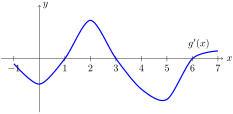
From the graph of \(g'(x)\) shown in FigureΒ 239, give all values of \(x\) for which \(g\) has a local minimum on \([-1,7]\) .
Graph of g prime of x. The curve is below the x-axis for x less than 1, above the x-axis for 1 less than x less than 3, below the x-axis for 3 less than x less than 6, and above the x-axis for x greater than 6. It crosses the x-axis at x equal to 1, 3, and 6, with a local maximum near x equal to 2 and local minima near x = 0 and x = 5.
Figure 239. Graph of \(g'(x)\text{.}\)
Answer.
Since \(g'(x)\) changes from negative to positive at \(x=1\) and \(x=6\) , there are local minimums at these values.

4.

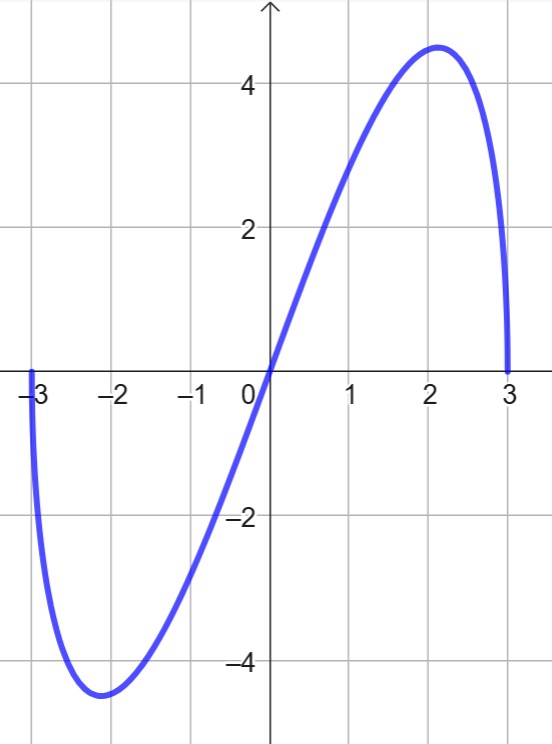
\(f(x) = x\sqrt{9-x^{2}}\) is graphed on \([-3,3]\) in FigureΒ 240. Given that
\begin{equation*} f'(x)=\frac{-x^{2}}{\sqrt{9-x^{2}}}+ \sqrt{9-x^{2}}, \end{equation*}
determine the exact value of \(x\) which gives the global minimum of \(f(x)\) on \([-3,3]\) . Decimal approximations will receive no credit.
Smooth curve with x-intercepts at x = -3, 0, and 3; a local minimum near (-2.1, -4.5); and a local maximum near (2.2, 4.4). The graph is negative on (-3, 0) and positive on (0, 3).
Figure 240. The graph of \(f(x)=x\sqrt{9-x^2}\) on \([-3,3]\text{.}\)
Answer.
\(f'(x)=0\) exactly when \(\displaystyle \frac{-x^{2} + (9-x^{2})}{\sqrt{9-x^{2}}}= 0\) which happens when \(9-2x^{2}=0\) . Solving this give \(x=\pm \frac{3}{\sqrt{2}}\) . The global minimum occurs at \(x=-\frac{3}{\sqrt{2}}\) .

5.

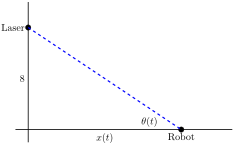
A laser mounted on a wall 8 feet above ground tracks a robot moving horizontally along the floor. At time \(t\) , the robot is \(x(t)\) feet away from the wall and moves so that \(\displaystyle \frac{dx}{dt}=5\) feet per second. The laser always points directly at the robot. Let \(\theta(t)\) be the angle of the beam above horizontal.
Diagram showing a laser mounted on a vertical wall and a robot moving along a horizontal floor. The wall and floor meet at a right angle at the lower-left corner. The laser is located on the wall 8 feet above the floor and is labeled β€œLaser.” The robot is located on the floor to the right of the wall and is labeled β€œRobot.” A dashed line segment connects the laser to the robot, representing the laser beam. The horizontal distance from the wall to the robot is labeled x(t). The angle between the laser beam and the floor at the robot is labeled ΞΈ(t). The height of the laser above the floor is labeled 8. The diagram forms a right triangle with vertical leg 8 feet, horizontal leg x(t), and hypotenuse given by the laser beam.
Figure 241. A laser tracks the movement of a robot.
  1. Write a relation between \(\theta(t)\) and \(x(t)\) .
  2. Find \(\dfrac{d\theta}{dt}\) when \(x=6\) . Be sure to include units in your response.
Answer.
  1. \(\displaystyle \displaystyle \tan \theta(t) = \frac{8}{x(t)}\)
  2. \(\displaystyle \sec^{2} \theta(t) \cdot \frac{d\theta}{dt}= \frac{x(t) \cdot 0 - 8 \frac{dx}{dt}}{x(t)^{2}}\) means that
    \begin{equation*} \displaystyle \frac{d\theta}{dt}= \frac{-8\frac{dx}{dt}}{x(t)^{2}}\cos^{2}\theta(t). \end{equation*}
    So at \(x=6\) we have \(\frac{d\theta}{dt}= \frac{-8(5)}{6^{2}}\cdot \frac{36}{100}= -0.4\) radians per second.

6.

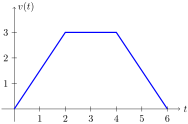
The velocity of an object (in m/s) on the interval \(0\le t\le 6\) is shown in FigureΒ 242. Compute the total distance traveled on \([0,6]\) . Include units.
Velocity graph: starts at (0, 0), rises linearly to (2, 3), stays at 3 until t = 4, then decreases linearly to (6, 0).
Figure 242. The velocity of an object on the interval \(0 \le t \le 6\text{.}\)
Answer.
Look at the area under the curve and above the \(t\)-axis to find 6+6 = 12 meters.

7.

Express the following quantity as sum using sigma notation:
\begin{equation*} (2\cdot 4) + (3\cdot 5) + (4\cdot 6) + \cdots + [n\cdot (n+2)]. \end{equation*}
Answer.
\(\displaystyle \sum_{k=2}^{n} k(k+2)\)

8.

Let
\begin{equation*} f(x)= \begin{cases}2x,&0\le x\le 1,\\ 2,&1< x\le 3.\end{cases} \end{equation*}
Compute the left Riemann sum, \(L_{4}\) , on \([0,3]\) .
Answer.
\begin{align*} L_{4} \mathstrut \amp = 0(3/4) + 2(3/4)(3/4) + 2(3/4) + 2(3/4) \\ \amp = \frac{9}{8}+ \frac{3}{2}+ \frac{3}{2} \\ \amp = \frac{33}{8} \\ \amp = 4.125 \end{align*}

9.

Evaluate the limit: \(\displaystyle \lim_{x \to 0}\frac{e^{3x}-1-3x}{x^{2}}.\)
Answer.
Both numerator and denominator \(\to 0\) . Apply L’HΓ΄pital:
\begin{equation*} \frac{d}{dx}(e^{3x}-1-3x)=3e^{3x}-3. \end{equation*}
Thus first application:
\begin{equation*} \lim_{x\to 0}\frac{3e^{3x}-3}{2x}= \lim_{x\to 0}\frac{3(e^{3x}-1)}{2x}. \end{equation*}
Still \(0/0\) . Apply L’HΓ΄pital again:
\begin{equation*} \frac{d}{dx}[3(e^{3x}-1)] = 9e^{3x}, \qquad \frac{d}{dx}[2x] = 2. \end{equation*}
Hence
\begin{equation*} \lim_{x\to 0}\frac{9e^{3x}}{2}= \frac{9}{2}. \end{equation*}

10.

The rectangles in the graph shown in FigureΒ 243 illustrate a left-endpoint Riemann sum \(\displaystyle \sum_{k=1}^{n} f(x_{k}^{*}) \ \Delta x\) for the function \(\displaystyle f(x) = 2\sqrt{x}+1\) on the interval \([1,8]\) .
Graph of y = square root of 2x + 1 with three left-endpoint rectangles on the interval [1, 8].
Figure 243. A left Riemann sum for \(f(x)=2\sqrt{x}+1\) on \([1,8]\text{.}\)
  1. What is the value of \(\Delta x\) in this Riemann sum?
  2. What is the value of \(n\) in this sum?
  3. Calculate the exact value of \(f(x_{2}^{*})\) .
  4. Give an explicit formula for \(x_{k}^{*}\) in terms of the index \(k\) in the sum \(\displaystyle \sum_{k=1}^{n} f(x_{k}^{*}) \ \Delta x.\)
Answer.
  1. \(\displaystyle \Delta x = \frac{8-1}{3}= \frac{7}{3}\)
  2. \(\displaystyle n=3\)
  3. \(x_{2}^{*} = 1+\frac{7}{3}= \frac{10}{3}\) so that \(f(x_{2}^{*}) = 2\sqrt{\frac{10}{3}}+ 1\) .
  4. \(\displaystyle x_{k}^{*} = 1+(k-1)\frac{7}{3}\)

11.

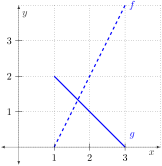
Two differentiable functions \(f\) and \(g\) are shown in FigureΒ 244 near \(x=2\) .
Graph of two line segments: f rises from (1, 0) to (3, 4), and g decreases from (1, 2) to (3, 0). The graphs intersect at (2, 1).
Figure 244. Graphs of \(f\) and \(g\) near \(x=2\text{.}\)
  1. Evaluate \(\displaystyle \lim_{x\to 2}\frac{f(x)}{g(x)}\) .
  2. Evaluate \(\displaystyle \lim_{x\to 2}\frac{f(x)-f(2)}{g(x)-g(2)}\) .
Answer.
  1. 2 (top tends to 2; bottom tends to 1)
  2. Use L’Hopital’s rule:
    \begin{equation*} \displaystyle \lim_{x \rightarrow 2}\frac{f'(x)}{g'(x)}= \frac{2}{-1}= -2 \end{equation*}

12.

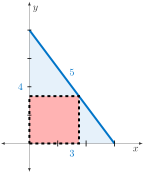
Determine the dimensions of the rectangle of largest area that can be inscribed in the 3-4-5 right triangle shown in FigureΒ 245.
Graph of the line from (0, 4) to (3, 0), forming a triangle in the first quadrant. A shaded rectangle is inscribed under the line with width about 1.75 and height about 1.6
Figure 245. A rectangle inscribed in a 3-4-5 triangle.
Answer.
We maximize \(A(x) = x(-\frac{4}{3}x+4)\) since the line is described by \(y=-\frac{4}{3}x+4\) and the value of \(x\) is positive in the diagram so that \(x\) would give the width of the rectangle. To maximize \(A(x) = -\frac{4}{3}x^{2} + 4x\) we find \(A'(x) = -\frac{8}{3}x+4\) which is 0 when \(x=\frac{3}{2}\) . This is a local maximum so that the optimal dimensions are a base width of \(\frac{3}{2}\) and a height of \(-\frac{4}{3}(\frac{3}{2}) + 4 = -2+4 = 2\) .