
Activity 18.
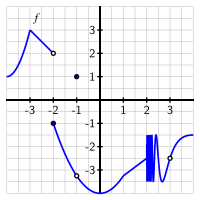
This activity builds on your work in Preview Activity 1.7.1, using the same function \(f\) as given by the graph that is repeated in the following figure. Assume that \(f(2) = -2.5\text{.}\)
ADD ALT TEXT TO THIS IMAGE
(a)
At which values of \(a\) does \(\lim_{x \to a} f(x)\) not exist?
Hint.
Consider the left- and right-hand limits at each value.
Answer.
\(a = -2\text{;}\) \(a = +2\text{.}\)
Solution.
\(\lim_{x \to a} f(x)\) does not exist at \(a = -2\) since \(\lim_{x \to -2^-} f(x) = 2 \ne -1 = \lim_{x \to -2^+}\) and \(\lim_{x \to a} f(x)\) does not exist at \(a = +2\) since \(\lim_{x \to 2^+} f(x)\) does not exist due to the infinitely oscillatory behavior of \(f\text{.}\)
(b)
At which values of \(a\) is \(f(a)\) not defined?
Hint.
Carefully examine places on the graph where there’s an open circle.
Answer.
\(a = 3\text{.}\)
Solution.
The only point at which \(f\) is not defined is at \(a = 3\text{.}\)
(c)
At which values of \(a\) does \(f\) have a limit, but \(\lim_{x \to a} f(x) \ne f(a)\text{?}\)
Hint.
Are there locations on the graph where the function has a limit but there’s a hole in the graph?
Answer.
\(a = -1\text{;}\) \(a = 3\text{.}\)
Solution.
At \(a = -1\text{,}\) note that \(\lim_{x \to -1} f(x)\) exists (and appears to have value approximately \(-3.25\)), but \(f(-1) = 1\text{,}\) and thus \(\lim_{x \to -1} f(x) \ne f(-1)\text{.}\) At \(a = 3\text{,}\) \(\lim_{x \to 3} f(x) = -2.5\text{,}\) but \(f(3)\) is not defined, so the limit exists but does not equal the function value.
(d)
State all values of \(a\) for which \(f\) is not continuous at \(x = a\text{.}\)
Hint.
Remember that at least one of three conditions must fail: if the function lacks a limit, if the function is undefined, or if the limit exists but does not equal the function value, then \(f\) is not continuous at the point.
Answer.
\(a=-2\text{;}\) \(a = 2\text{;}\) \(a = 3\text{;}\) \(a = -1\text{.}\)
Solution.
Based on our work in (a), (b), and (c), \(f\) is not continuous at \(a=-2\) and \(a = 2\) because \(f\) does not have a limit at those points; \(f\) is not continuous at \(a = 3\) since \(f\) is not defined there; and \(f\) is not continuous at \(a = -1\) because at that point its limit does not equal its function value.
(e)
Which condition is stronger, and hence implies the other: \(f\) has a limit at \(x = a\) or \(f\) is continuous at \(x = a\text{?}\) Explain, and hence complete the following sentence: “If \(f\) at \(x = a\text{,}\) then \(f\) at \(x = a\text{,}\)” where you complete the blanks with has a limit and is continuous, using each phrase once.
Hint.
Note that the definition of being continuous requires the limit to exist.
Answer.
“If \(f\)is continuous at \(x = a\text{,}\) then \(f\)has a limit at \(x = a\text{.}\)”
Solution.
“If \(f\)is continuous at \(x = a\text{,}\) then \(f\)has a limit at \(x = a\text{,}\)” since one of the defining properties of “being continuous” at \(x = a\) is that the function has a limit at that input value. This shows that being continuous is a stronger condition than having a limit.

