Handout Daily Prep 5.2 - The Second Fundamental Theorem of Calculus

Section Overview

To this point, you have become reasonably proficient at computing the derivative of a given function algebraically, graphically, and numerically. In this section, we find a single formula that defines an antiderivative of any function \(f(t)\text{.}\) The second part of the Fundamental Theorem of Calculus will also enable us to better see how the processes of differentiation and integration are related as near inverse processes.

Section Basic learning objectives

These are the tasks you should be able to perform with reasonable fluency when you arrive at our next class meeting. Important new vocabulary words are indicated in italics.
  • Evaluate integrals that have a variable in one of their limits.
  • State the Second Fundamental Theorem of Calculus and use it to state an antiderivative for a given function.

Section To prepare for class

Complete all actions listed below. Respond to the questions highlighted with Submit.
  • Read motivating questions and the introduction to section 5.2 (up until Preview Activity 5.2.1).
  • Do these problems.
    1. Consider the constant function \(f(t) = 4\text{.}\)
      1. Using geometry, compute \(\displaystyle \int_{1}^{2} f(t) \ dt\text{.}\)
      2. Using geometry, compute \(\displaystyle \int_{1}^{4} f(t) \ dt\text{.}\)
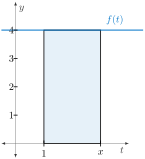
      3. Compute \(\displaystyle \int_{1}^{x} f(t) \ dt\) for any \(x \geq 1\text{.}\) FigureΒ 138 may help.
        A horizontal line at y = 4 represents f(t). A shaded rectangle extends from t = 1 to t = x, with height 4.
        Figure 138. The area under \(f(t)=4\) on the interval \([1,x]\text{.}\)
      4. Define the area function \(\displaystyle A(x) = \int_{1}^{x} f(t) \ dt\text{,}\) \(1 \leq x \leq 4\text{.}\) What is \(A(2.5)\text{?}\) \(A(1)\text{?}\) Write a general formula for \(A(x)\text{.}\)
    2. Let \(f(t) = 2t+2\) for all \(t\text{.}\)
      1. Using geometry, compute \(\displaystyle \int_{0}^{2} f(t) \ dt\text{.}\)
      2. Using geometry, compute \(\displaystyle \int_{0}^{4} f(t) \ dt\text{.}\)
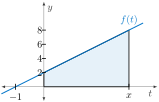
      3. Compute \(\displaystyle \int_{0}^{x} f(t) \ dt\) for any \(x \geq 0\text{.}\) FigureΒ 139 may help.
        A straight line labeled f(t) increases from left to right. The shaded region is the area under the line from t = 0 to t = x, forming a triangle.
        Figure 139. The area under \(f(t)=2t+2\) on the interval \([0,x]\text{.}\)
      4. Define another area function \(\displaystyle B(x) = \int_{0}^{x} f(t) \ dt\text{.}\) What is \(B(2)\text{?}\) \(B(4)\text{?}\) \(B(0)\text{?}\) Write a general formula for \(B(x)\text{.}\)
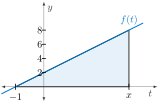
      5. Define a third area function \(\displaystyle C(x) = \int_{-1}^{x} f(t) \ dt\) for any \(x \geq -1\text{.}\) What is \(C(2)\text{?}\) \(C(4)\text{?}\) \(C(-1)\text{?}\) Write a general formula for \(C(x)\text{.}\) FigureΒ 140 may help.
        A straight line labeled f(t) rises from left to right. The shaded region is the area under the line from t = 0 to t = x, with a vertical line at t = x forming the right boundary.
        Figure 140. The area under \(f(t)=2t+2\) on the interval \([-1,x]\text{.}\)
    3. In the two previous problems, we have computed three different area functions.
      1. Fill in the blanks:
        Table 141. For functions \(A(x), B(x)\) and \(C(x)\) from the previous two exercises, do you spot a pattern with their derivatives?
        \(A(x) = {\hspace{40mm}}\) \(A'(x) = {\hspace{40mm}} \)
        \(B(x) ={\hspace{40mm}}\) \(B'(x) ={\hspace{40mm}}\)
        \(C(x) ={\hspace{40mm}}\) \(C'(x) ={\hspace{40mm}}\)
      2. You should notice a very interesting fact about the derivatives of the area functions - a fundamentally beautiful property. What is it?
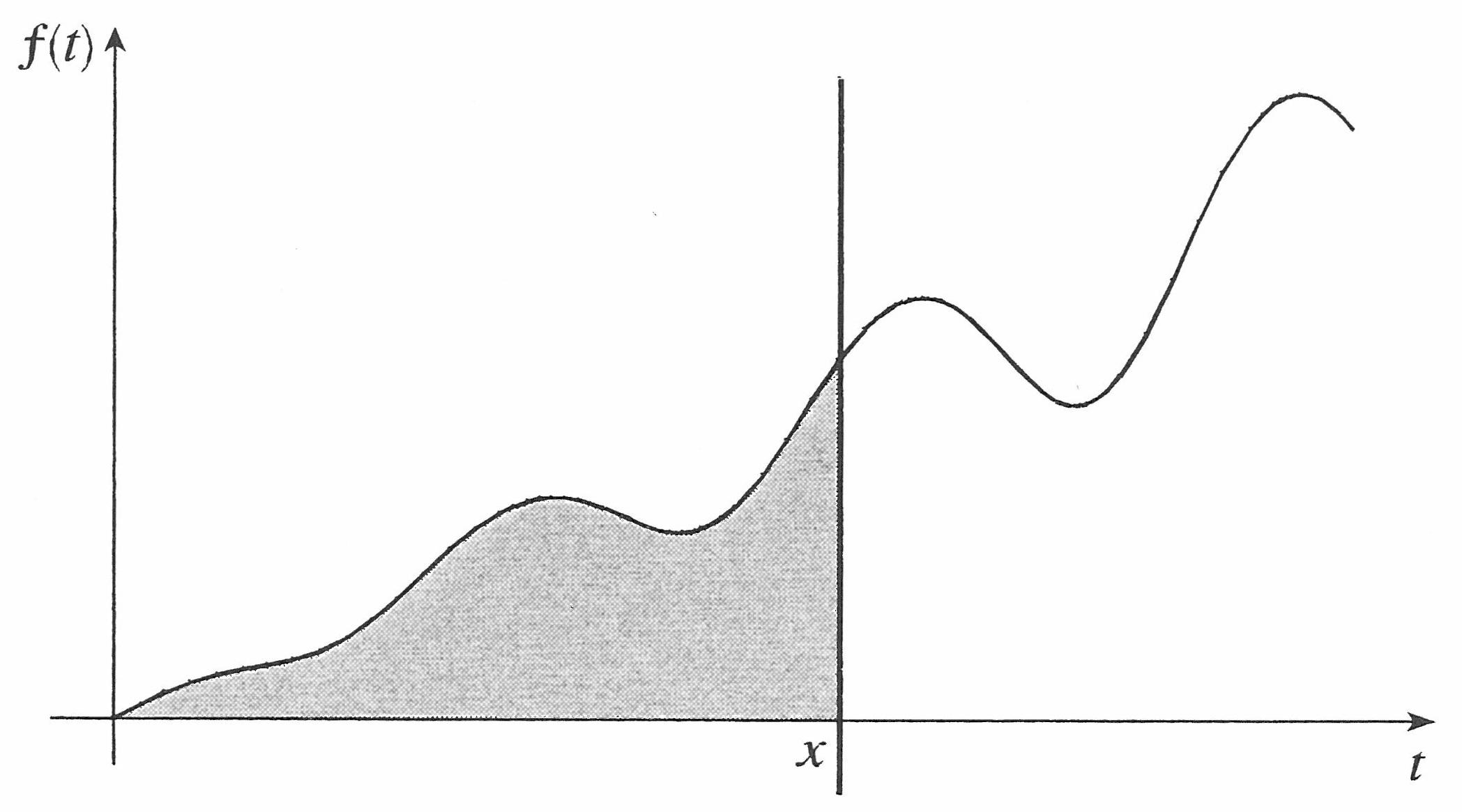
      3. Define one final function, \(\displaystyle D(x) = \int_{0}^{x} 0.2t \sin(\cos(\sin t)) \ dt\text{.}\) Don’t worry about trying to find a simple formula for \(D(x)\text{.}\) But, using our amazing fact, compute \(D'(x)\text{.}\)
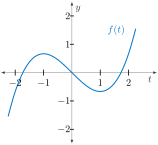
        Graph of f(t) with a shaded region under the curve from the left up to t = x, where a vertical line at t = x marks the right boundary of the shaded area.
        Figure 142. An illustration of \(\displaystyle D(x) = \int_{0}^{x} 0.2t \sin(\cos(\sin t)) \ dt\text{.}\)
  • πŸ“ [Submit] Read section 5.2.2 up to Activity 5.2.2.
    1. In equation 5.2.1, it is claimed that
      \begin{equation*} \lim_{h \rightarrow 0}\frac{\int_{c}^{x+h}f(t) \ dt - \int_{c}^{x} f(t) \ dt}{h}= \lim_{h \rightarrow 0}\frac{\int_{x}^{x+h}f(t) \ dt}{h}. \end{equation*}
      The author explains why this is true with an equation. Draw a well-labeled figure using the graph of \(f(t)\) and areas under that curve that illustrates why the numerators are indeed equal for any function \(f(t)\text{.}\) Hint: A property from section 4.3.3 may help.
    2. The author goes on to say β€œNow, observe that for small values of \(h\text{,}\)
      \begin{equation*} \int_{x}^{x+h}f(t) \ dt \approx f(x) \cdot h, \end{equation*}
      by a simple left-hand approximation of the integral.” Show this is also the case by drawing a well-labeled figure illustrating this one-rectangle Riemann sum.
  • πŸ“ [Submit] Do Activity 5.2.2. If you get stuck, you may watch the video solution to Activity 5.2.2 (8:09).
  • Prompt Copilot β€œWhat is the difference between d/dx(int_a\(\wedge\)x f(t) dt) and int_a\(\wedge\)x f’(t) dt?”
  • Prompt Copilot β€œCan you show me a standard example from calculus in which I need to apply both the second Fundamental Theorem of Calculus and the chain rule?”
  • πŸ“ [Submit] Explore applet Second Fundamental Theorem of Calculus. Enter \(f(x)=\cos(x^{2})\) and Starting \(x\)-value: 0 and then answer these questions:
    1. Place the dot labeled β€˜\(x\)’ at 1 on the \(x\)-axis. Give an expression that represents the area of the purple shaded region.
    2. Give an expression that represents \(F(x)\) as defined in the applet.
    3. Check the β€˜Show the graph of \(F\)’ box in the lower left. Slide point β€˜x’ left and right to sketch out \(F(x)\text{.}\) Which of the following best describes the function \(F(x)\) drawn?
      • \(F(x)\) is the net signed area of the purple shaded area under \(f(x) = \cos(x^{2})\) from 0 to \(x\text{.}\)
      • \(F(x)\) is the antiderivative of \(f(x)=\cos(x^{2})\) that satisfies \(F(0)=0\text{.}\)
      • \(F'(x)=\cos(x^{2})\text{.}\)
    4. What does the applet illustrate to you?
    Suggestions for submission.
    1. \(\displaystyle \displaystyle \int_{0}^{x} \cos(t^{2}) \ dt\)
    2. \(\displaystyle \displaystyle F(x) = \int_{0}^{x} \cos(t^{2}) \ dt\)
    3. All three options describe \(F(x)\text{.}\)
    4. The applet should illustrate how the area function \(F(x)\) relates to its integrand via the Second Fundamental Theorem of Calculus. Of course, your viewpoints will vary.

Checkpoint 143. Differentiate the Integral Function.

Section After class

Solidifying the concepts discussed in class through practice is necessary to build your skills.

Section Advanced learning objectives

In addition to mastering the basic objectives, here are the tasks you should be able to perform after class, with practice:
  • Use the Second Fundamental Theorem of Calculus to differentiate an integral that has a variable in its limits.
  • Analyze an integral function using the usual techniques from differential calculus.
  • Recognize the difference between a definite integral that evaluates to a number (such as \(\int_{1}^{2} x \ dx\)) and a definite integral that evaluates to a function (such as \(\int_{1}^{x} t \ dt\)).

Section Additional suggestions

Section Answers

Subsection To prepare for class

    1. \(\displaystyle 4(x-1)\)
    2. \(A(2.5)=6, A(1)=0\text{,}\) and \(A(x)=4(x-1)\)
    1. \(\displaystyle 2(2)+\frac{1}{2}(2)(4)=8\)
    2. \(\displaystyle x^{2}+2x\)
    3. \(B(2)=8, B(4)=24, B(0)=0\text{,}\) and \(B(x)=x^{2}+2x\)
    4. \(C(2)=9, C(4)=25, C(-1)=0\text{,}\) and \(C(x)=x^{2}+2x+1\)
    1. This summarizes the results of the previous two problems.
      Table 146. Functions \(A(x), B(x)\) and \(C(x)\) and their derivatives.
      \(A(x) = 4(x-1){\hspace{30mm}}\) \(A'(x) = 4{\hspace{30mm}}\)
      \(B(x) = x^{2}+2x\) \(B'(x) = 2x+2\)
      \(C(x) = x^{2}+2x+1\) \(C'(x) = 2x+2\)
    2. The derivative of \(\displaystyle \int_{a}^{x} f(t) \ dt = f(x)\text{.}\)
    3. \(\displaystyle D'(x) = 0.2x \sin(\cos(\sin(x)))\)

Subsection Additional suggestions

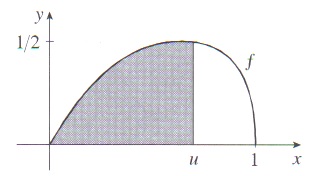
    1. \([0,1]\text{;}\) \([0,1/2]\text{.}\)
    2. Yes to both. \(g'(u) = f(u)\text{.}\)
    3. Maximum at \(u=1\text{.}\) Minimum at \(u=0\text{.}\)
    4. \(g''(u) > 0\) when \(f'(u) > 0\) which is approximately \((0,2/3)\text{.}\) \(g''(u)<0\) when \(f'(u) < 0\) which is approximately \((2/3,1)\text{.}\)
  1. \(F'(x) = f(x)\) and \(F''(x) = f'(x) < 0\) on \((-1,1)\text{.}\) So, \(F(x)\) is concave downward on \((-1,1)\text{.}\)
  2. \(H'(x) = F'(g(x))\cdot g'(x) = e^{-g(x)^2}\cdot 3 = e^{-(3x)^2}\cdot 3 = 3e^{-9x^2}\text{.}\)
  3. \(\displaystyle \frac{d}{dx}\int_{0}^{x} f(t) \ dt = \frac{d}{dx}(x \cos(\pi x)\) so that \(f(x) = 1\cdot \cos(\pi x) + x(-\pi \sin(\pi x))\text{.}\) It follows then that \(f(6) = \cos(6\pi) - 6\pi\sin(6\pi) = 1\text{.}\)