To this point, you have become reasonably proficient at computing the derivative of a given function algebraically, graphically, and numerically. In this section, we find a single formula that defines an antiderivative of any function \(f(t)\text{.}\) The second part of the Fundamental Theorem of Calculus will also enable us to better see how the processes of differentiation and integration are related as near inverse processes.
These are the tasks you should be able to perform with reasonable fluency when you arrive at our next class meeting. Important new vocabulary words are indicated in italics.
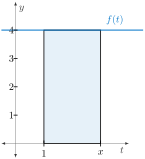
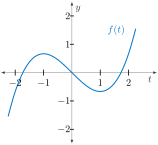
Define the area function\(\displaystyle A(x) = \int_{1}^{x} f(t) \ dt\text{,}\)\(1 \leq x \leq 4\text{.}\) What is \(A(2.5)\text{?}\)\(A(1)\text{?}\) Write a general formula for \(A(x)\text{.}\)
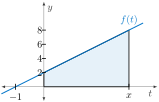
Define another area function\(\displaystyle B(x) = \int_{0}^{x} f(t) \ dt\text{.}\) What is \(B(2)\text{?}\)\(B(4)\text{?}\)\(B(0)\text{?}\) Write a general formula for \(B(x)\text{.}\)
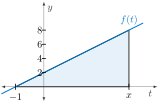
Define a third area function \(\displaystyle C(x) = \int_{-1}^{x} f(t) \ dt\) for any \(x \geq -1\text{.}\) What is \(C(2)\text{?}\)\(C(4)\text{?}\)\(C(-1)\text{?}\) Write a general formula for \(C(x)\text{.}\)Figure 140 may help.
Define one final function, \(\displaystyle D(x) = \int_{0}^{x} 0.2t \sin(\cos(\sin t)) \ dt\text{.}\) Don’t worry about trying to find a simple formula for \(D(x)\text{.}\) But, using our amazing fact, compute \(D'(x)\text{.}\)
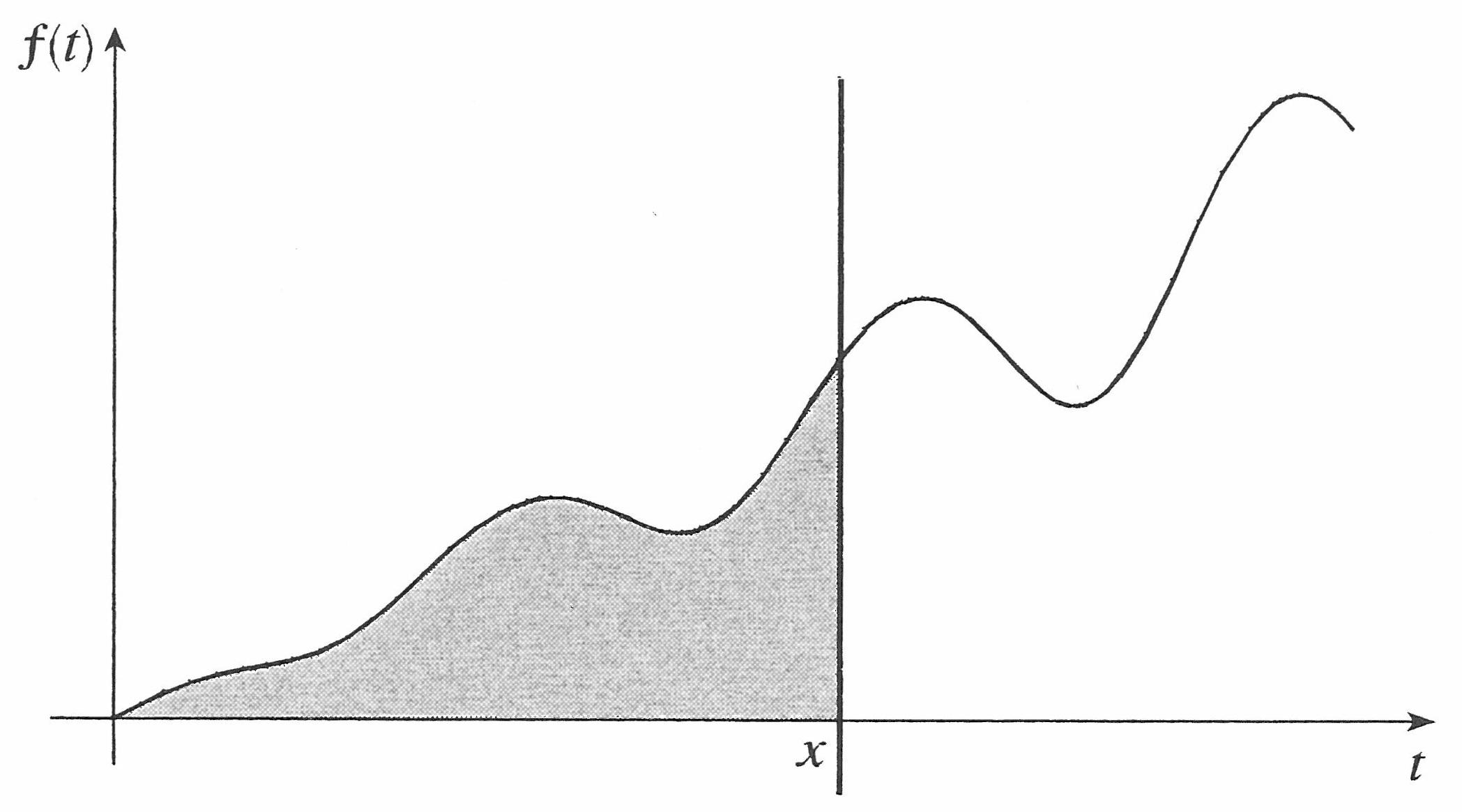
The author explains why this is true with an equation. Draw a well-labeled figure using the graph of \(f(t)\) and areas under that curve that illustrates why the numerators are indeed equal for any function \(f(t)\text{.}\)Hint: A property from section 4.3.3 may help.
by a simple left-hand approximation of the integral.” Show this is also the case by drawing a well-labeled figure illustrating this one-rectangle Riemann sum.
Prompt Copilot “Can you show me a standard example from calculus in which I need to apply both the second Fundamental Theorem of Calculus and the chain rule?”
📝 [Submit] Explore applet Second Fundamental Theorem of Calculus. Enter \(f(x)=\cos(x^{2})\) and Starting \(x\)-value: 0 and then answer these questions:
Check the ‘Show the graph of \(F\)’ box in the lower left. Slide point ‘x’ left and right to sketch out \(F(x)\text{.}\) Which of the following best describes the function \(F(x)\) drawn?
The applet should illustrate how the area function \(F(x)\) relates to its integrand via the Second Fundamental Theorem of Calculus. Of course, your viewpoints will vary.
Explore the applet Fundamental Theorem of Calculus. Note: Ignore the title of the applet. This applet illustrates the Second Fundamental Theorem as described in our text. As always, let the questions at the bottom guide your exploration. This applet demonstrates how integration and differentiation are nearly inverse processes well.
Recognize the difference between a definite integral that evaluates to a number (such as \(\int_{1}^{2} x \ dx\)) and a definite integral that evaluates to a function (such as \(\int_{1}^{x} t \ dt\)).
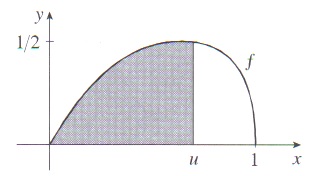
Let \(\displaystyle F(x) = \int_{1}^{x} f(t) \ dt\text{,}\) where \(f\) is the function whose graph is shown in Figure 145. Where is \(F\) concave downward? Explain.