
Activity 48.
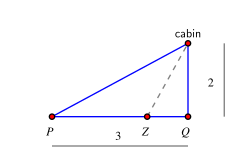
A hiker starting at a point \(P\) on a straight road walks east towards point \(Q\text{,}\) which is on the road and 3 kilometers from point \(P\text{.}\) Two kilometers due north of point \(Q\) is a cabin. The hiker will walk down the road for a while, at a pace of 8 kilometers per hour. At some point \(Z\) between \(P\) and \(Q\text{,}\) the hiker leaves the road and makes a straight line towards the cabin through the woods, hiking at a pace of 3 kph, as pictured in the provided figure. In order to minimize the time to go from \(P\) to \(Z\) to the cabin, where should the hiker turn into the forest?
Hint.
Let \(x\) be the distance from \(Z\) to \(Q\text{.}\) What is then the distance from \(P\) to \(Z\) in terms of \(x\text{?}\) How about the distance from \(Z\) to the cabin? How does time depend on distance and rate?
Answer.
The absolute minimum time the hiker can achieve is \(0.99302\) hours, which is attained by hiking about 2.2 km from \(P\) to \(Q\) and then turning into the woods for the remainder of the trip.
Solution.
We begin by letting \(x\) be the distance from \(Z\) to \(Q\text{.}\) Since it is 3 km from \(P\) to \(Q\text{,}\) the distance from \(P\) to \(Z\) is \(3-x\text{.}\) Further, by the Pythagorean Theorem, the distance from \(Z\) to the cabin is \(\sqrt{4+x^2}\text{.}\)
Next, we want to determine the hiker’s time as a function of \(x\text{.}\) Because distance equals rate times time, time is thus distance divided by rate. Along the road, the hiker’s distance is \(3-x\) km and her rate is \(8\) km/hr, thus her time on the road, \(T_r\) is
\begin{equation*}
T_r = \frac{3-x}{8}\text{.}
\end{equation*}
Once she enters the woods, her rate drops to \(3\) km/hr and travels a distance of \(\sqrt{4+x^2}\) km, making her time in the woods, \(T_w\text{,}\) given by
\begin{equation*}
T_w = \frac{\sqrt{4+x^2}}{3}\text{.}
\end{equation*}
Thus, the hiker’s total time is given by the function
\begin{equation*}
T(x) = \frac{3-x}{8} + \frac{\sqrt{4+x^2}}{3}\text{.}
\end{equation*}
Because the only values of \(x\) that make sense to use are \(0 \le x \le 3\) (using either negative values or values greater than 3 clearly add unnecessary time to the trip), we use this domain for \(T\) and now seek the absolute minimum of \(T\) on \([0,3]\text{.}\) First, we find that
\begin{equation*}
T'(x) = -\frac{1}{8} + \frac{1}{3} \cdot \frac{1}{2} (4+x^2)^{-1/2} (2x) = -\frac{1}{8} + \frac{x}{3\sqrt{4+x^2}}\text{.}
\end{equation*}
Setting \(T'(x) = 0\) and solving for \(x\text{,}\) we have \(\frac{x}{3\sqrt{4+x^2}} = \frac{1}{8}\text{,}\) so \(8x = 3\sqrt{4+x^2}\text{.}\) Squaring both sides, \(64x^2 = 9(4+x^2) = 36 + 9x^2\text{.}\) Hence, \(55x^2 = 36\text{,}\) so \(x = \sqrt{\frac{36}{55}} \approx 0.80904\text{.}\) (We don’t consider the critical number \(x = -\sqrt{\frac{36}{55}}\) because this doesn’t lie in the relevant domain of \(T\text{.}\))
Finally, we evaluate \(T\) at the only critical number in the interval and at the interval’s endpoints. Doing so, we find \(T(0) = \frac{3}{8} + \frac{2}{3} \approx 1.0417\text{,}\) \(T(3) = \frac{\sqrt{13}}{3} \approx 1.20185\text{,}\) and \(T(\sqrt{\frac{36}{55}}) = \frac{3}{8} + \frac{\sqrt{55}}{12} \approx 0.99302\text{,}\) and thus the absolute minimum time the hiker can achieve is \(0.99302\) hours, which is attained by hiking about 2.2 km from \(P\) to \(Q\) and then turning into the woods for the remainder of the trip.

