
Activity 61.
Suppose that \(f(t) = \frac{t}{1+t^2}\text{.}\)
Note that while we know a function whose derivative is \(\frac{1}{1+t^2}\text{,}\) namely \(\arctan(t)\text{,}\) we haven’t yet encountered an elementary function whose derivative is \(f(t) = \frac{t}{1+t^2}\text{.}\)
Let \(F(x) = \int_0^x f(t) \, dt\text{.}\) We will explore \(F(x)\) from numerical, graphical, and algebraic perspectives.
(a)
What is the key relationship between \(F\) and \(f\text{,}\) according to the Second FTC?
Hint.
Recall the statement of the Second FTC.
Answer.
\(F' = f\text{.}\)
Solution.
\(F' = f\text{,}\) by the Second FTC.
(b)
Analyze the first derivative of \(F\) algebraically to determine the intervals on which \(F\) is increasing and decreasing.
Hint.
Where is \(F'\) positive? \(F'\) negative?
Answer.
\(F\) is increasing for all \(x \gt 0\text{;}\) \(F\) is decreasing for \(x \lt 0\)
Solution.
\(F\) is increasing wherever \(F'=f\) is positive, so for all \(x \gt 0\text{.}\) Similarly, \(F\) is decreasing for \(x \lt 0\)
(c)
Analyze the second derivative of \(F\) algebraically to determine the intervals on which \(F\) is concave up and concave down. Note that \(f'(t)\) can be simplified to be written in the form \(f'(t) = \frac{1-t^2}{(1+t^2)^2}\text{.}\)
Hint.
Note that \(F'' = f'\text{.}\)
Answer.
\(F\) is CCU on \(-1 \lt x \lt 1\) and CCD for \(x \lt -1\) and \(x \gt 1\text{.}\)
Solution.
\(F\) is CCU wherever \(F' = f\) is increasing or wherever \(F'' = f'\) is positive. It is straightforward to show that \(f''\) is positive for \(-1 \lt x \lt 1\) and negative otherwise, thus \(F\) is CCU on \(-1 \lt x \lt 1\) and CCD for \(x \lt -1\) and \(x \gt 1\text{.}\)
(d)
Use a Riemann sum calculator with midpoints and 10 subintervals to calculate approximate values of \(F(x)\) in the table shown below.
Note that \(F(0)=\int_0^0 f(t) \, dt = 0\text{.}\)
| \(x\) | \(-10\) | \(-5\) | \(0\) | \(5\) | \(10\) |
|---|---|---|---|---|---|
| \(F(x)\) | 0 |
Hint.
Remember that \(F(5) = \int_0^5 \frac{t}{1+t^2} \, dt\text{.}\)
Answer.
| \(x\) | \(-10\) | \(-5\) | \(0\) | \(5\) | \(10\) |
|---|---|---|---|---|---|
| \(F(x)\) | 2.35973 | 1.64038 | 0 | 1.64038 | 2.35973 |
Solution.
\(F(5) = \int_0^5 \frac{t}{1+t^2} \, dt \approx 1.64038\text{,}\) using a midpoint Riemann sum with 10 subintervals. Similarly, \(F(10) = \int_0^{10} \frac{t}{1+t^2} \, dt \approx 2.35973\text{,}\) and \(F(-5) = \int_0^{-5} \frac{t}{1+t^2} \, dt \approx 1.64038\text{,}\) and finally \(F(-10) = \int_0^{-10} \frac{t}{1+t^2} \, dt \approx 2.35973\)
(e)
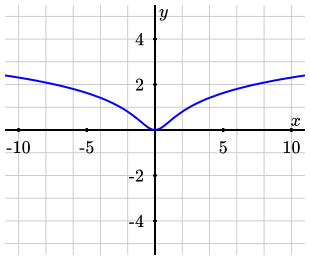
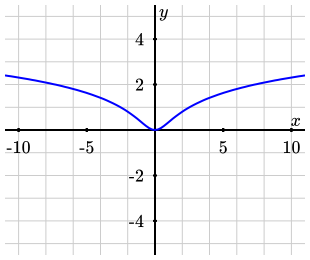
Use your work above to sketch an accurate graph of \(y = F(x)\) on the axes provided.
Hint.
Use the table of values along with the intervals where \(F\) is increasing, decreasing, concave up and concave down.
Answer.
Solution.
Using the values and information we’ve found in (b)-(d), we arrive at the following figure.
(f)
Now consider the function \(g(x)=\frac{1}{2}\ln(1+x^2)\text{.}\) Calculate \(g(0)\) and \(g'(x)\text{.}\) Use appropriate computing technology to plot the graph of \(g(x)\text{.}\) What can you conclude about the functions \(F(x)\) and \(g(x)\text{?}\)
Hint.
Use the chain rule to calculate \(g'(x)\text{,}\) and note that \(g(0)=\frac{1}{2}\ln(1+0^2)=\frac{1}{2}\ln(1)=0\text{.}\)
Answer.
\(g'(x)=\frac{x}{1+x^2}\) and \(g(0)=0\text{.}\) \(F=g\)
Solution.
The function \(g(x)\) has derivative \(g'(x)=\frac{x}{1+x^2}\) and \(g(0)=0\text{.}\) As further confirmed by graphing \(g(x)\) and \(F(x)\) together, the functions \(g\) and \(F\) are the same function, described in different ways.

