Skip to main content
Contents
Search Book
Search Results:
No results.
Embed Readability settings Prev Up Next \(\newcommand{\N}{\mathbb N}
\newcommand{\Z}{\mathbb Z}
\newcommand{\Q}{\mathbb Q}
\newcommand{\R}{\mathbb R}
\newcommand{\lt}{<}
\newcommand{\gt}{>}
\newcommand{\amp}{&}
\definecolor{fillinmathshade}{gray}{0.9}
\newcommand{\fillinmath}[1]{\mathchoice{\colorbox{fillinmathshade}{$\displaystyle \phantom{\,#1\,}$}}{\colorbox{fillinmathshade}{$\textstyle \phantom{\,#1\,}$}}{\colorbox{fillinmathshade}{$\scriptstyle \phantom{\,#1\,}$}}{\colorbox{fillinmathshade}{$\scriptscriptstyle\phantom{\,#1\,}$}}}
\)
Handout Exam 2 - Spring 2026
Section Topics
Be sure to try each question before looking at the solutions.
Exercises Questions
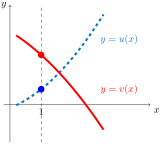
1. \(u\) and \(v\) are graphed below near \(x=1\) . Note: These graphs are symmetric about a horizontal line defined where they intersect.
Figure 230. The graphs of \(u(x)\) and \(v(x)\text{.}\)
Without formulas, determine the
sign (positive, negative, or zero) of
\((uv)'(1)\) . Explain using the product rule and the picture.
Determine the
sign of
\(\left(\dfrac{u}{v}\right)'(1)\) . Explain using the quotient rule and the picture.
Answer .
At \(x=1\) , the graph shows: \(u(1) > 0, u'(1) > 0,\) \(v(1) > 0,{\text{ and }}v'(1) = - u'(1) < 0.\) Note that
\begin{equation*}
(uv)'(1) = u'(1)v(1)+u(1)v'(1).
\end{equation*}
The first term is positive (positive slope times positive value). The second term is negative (positive times negative). Since, \(v'(1)=-u'(1)\) and \(0 < u(1) < v(1)\) , the first (positive) term dominates.
Note that
\begin{equation*}
\displaystyle \left( \frac{u}{v}\right)'(1) = \frac{u'(1)v(1)-u(1)v'(1)}{v(1)^{2}}.
\end{equation*}
The denominator is positive. In the numerator, \(u'(1)v(1) > 0\) and \(-u(1)v'(1)\) is also positive since \(v'(1)<0\) . Adding these is positive. Hence the fraction is also positive.
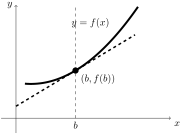
2. \(f\) is strictly increasing and differentiable. Its graph and a tangent line at \(x=b\) are shown in Figure 231 . The slope of the tangent line is \(\displaystyle m=\frac{3}{2}\) . Let \(g=f^{-1}\) . Compute \(g'\big(f(b)\big)\) .
Figure 231. Graph a function \(f(x)\) and its tangent line at \(x=b\text{.}\)
Answer .
Slope of tangent to \(f\) at \(x=b\) is \(m = \frac{3}{2}.\) Since \(g=f^{-1}\) ,
\begin{equation*}
\displaystyle g'(f(b)) = \frac{1}{f'(b)}= \frac{1}{3/2}= \frac{2}{3}.
\end{equation*}
3. \(F(x)=\sqrt{4x^{2}+3}\) . Compute \(F'(x)\) and then evaluate \(F'(2)\) (exact value only).
Answer .
\begin{align*}
F'(x) \mathstrut \amp =\frac{1}{2}(4x^{2}+3)^{-1/2}\cdot 8x \\
\amp = \frac{4x}{\sqrt{4x^{2}+3}}.
\end{align*}
so that
\begin{align*}
F'(2)\mathstrut \amp =\frac{8}{\sqrt{16+3}} \\
\amp = \frac{8}{\sqrt{19}}.
\end{align*}
4. \(f\) is differentiable and satisfies \(f(3)=7\) and \(f'(3)=-1.6\) .
Find the linearization
\(L(x)\) at
\(x=3\) .
Use
\(L(x)\) to estimate
\(f(3.3)\) .
If you are told
\(f''(3)>0\) , explain in one sentence whether your estimate in (b) is likely an overestimate or underestimate of
\(f(3.3)\) .
Answer .
\(\displaystyle L(x)=f(3)+f'(3)(x-3)=7-1.6(x-3).\)
\(\displaystyle f(3.3)\approx L(3.3)=7 -1.6(0.3)=7-0.48 = 6.52.\)
If
\(f''(3)>0\) ,
\(f\) is likely concave up near
\(x=3\) . The tangent line then lies
below the curve, so the linear approximation is an underestimate.
5.
\(\displaystyle h(x)= 5x^{4} - 3x + \dfrac{2}{x}\)
\(\displaystyle q(x)= (3x^{2}+1)\sin x\)
\(\displaystyle r(x)= \dfrac{x^3}{2x-5}\)
Answer .
\(\displaystyle h'(x)=20x^{3} - 3 - \frac{2}{x^{2}}.\)
\(\displaystyle q'(x)=6x\sin x + (3x^{2}+1)\cos x.\)
Use the quotient rule:
\begin{align*}
r'(x) \mathstrut \amp =\frac{3x^{2}(2x-5)-x^{3}(2)}{(2x-5)^{2}}\\
\amp =\frac{6x^{3}-15x^{2}-2x^{3}}{(2x-5)^{2}}\\
\amp =\frac{4x^{3}-15x^{2}}{(2x-5)^{2}}.
\end{align*}
6. \(H(t)\) (in meters) of water in a tank is decreasing at a rate of \(0.12\) m/min. The water temperature \(T\) (in \(^{\circ}\) C) changes with height according to \(T(H)=18 + 0.5H.\)
Compute
\(\dfrac{dT}{dt}\) at the instant the water is 2 m deep.
Interpret your answer with units in one sentence.
Answer .
From the chain rule,
\begin{align*}
\frac{dT}{dt}\mathstrut \amp =\frac{dT}{dH}\frac{dH}{dt}\\
\amp =0.5(-0.12) \\
\amp = -0.06\ \text{°C/min}.
\end{align*}
The water temperature is decreasing at a rate of
\(0.06^{\circ}\text{C per minute}.\)
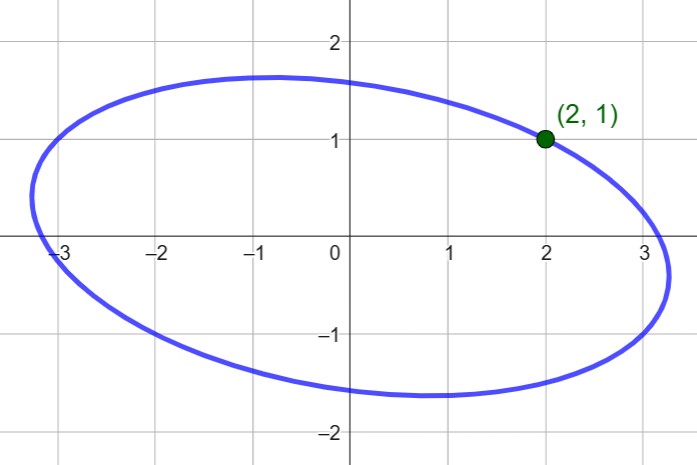
7. \(\displaystyle x^{2}+xy+4y^{2}=10\) at the ordered pair \((2,1)\) .
Figure 232. A graph of \(\displaystyle x^{2}+xy+4y^{2}=10
\text{.}\)
Answer .
Differentiate:
\begin{equation*}
2x + (x y' + y) + 8y y' = 0.
\end{equation*}
Group \(y'\) terms:
\begin{equation*}
y'(x+8y)=-(2x+y),
\end{equation*}
\begin{equation*}
y' = \frac{-(2x+y)}{x+8y}.
\end{equation*}
At \((2,1)\) :
\begin{equation*}
y'=\frac{-(4+1)}{2+8}=\frac{-5}{10}=-\frac{1}{2}.
\end{equation*}
Tangent line:
\begin{equation*}
y-1 = -\frac{1}{2}(x-2).
\end{equation*}
8.
You know that at \(x=4\text{,}\)
\begin{equation*}
u(4)=3,\quad u'(4)=2.1,\quad v(4)=5,\quad v'(4)=-0.6.
\end{equation*}
Let
\(P(x)=u(x)v(x)\) and
\(Q(x)=\dfrac{u(x)}{v(x)}\text{.}\)
Explain in one sentence whether
\(P\) is increasing or decreasing at
\(x=4\) .
Answer .
We have
\begin{align*}
P'(4)\mathstrut \amp =u'(4)v(4)+u(4)v'(4) \\
\amp =2.1(5)+3(-0.6) \\
\amp =10.5 - 1.8 \\
\amp = 8.7.
\end{align*}
We have
\begin{align*}
Q'(4) \mathstrut \amp =\frac{u'(4)v(4)-u(4)v'(4)}{v(4)^{2}}\\
\amp =\frac{2.1(5)-3(-0.6)}{25} \\
\amp =\frac{10.5+1.8}{25} \\
\amp =\frac{12.3}{25} \\
\amp = 0.492.
\end{align*}
Since
\(P'(4)=8.7>0\) ,
\(P \text{ is increasing at }x=4.\)
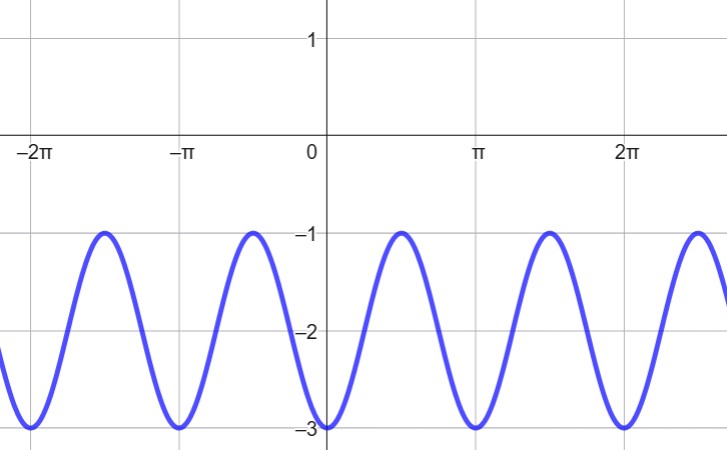
9. \(p(x)\) is shown. Which of the following is most likely to represent \(p'(x)\) ? [Check the appropriate box(es).]
Figure 233. A graph of \(p(x)\) which is periodic.
\(\square\)
\(\displaystyle \sin(2x)\)
\(\square\)
\(\displaystyle -\cos(2x)\)
\(\square\)
\(\displaystyle 2\sin(x)\)
\(\square\)
\(\displaystyle -2\cos(x)\)
\(\square\)
\(\displaystyle 2\sin(2x)\)
\(\square\)
\(\displaystyle -2\cos(2x)\)
\(\square\)
\(\displaystyle 2\sin(x)-2\)
\(\square\)
\(\displaystyle -2\cos(x)-2\)
\(\square\)
\(\displaystyle -2\sin(x)\)
\(\square\)
\(\displaystyle 2\cos(x)\)
\(\square\)
\(\displaystyle 2\sin(\frac{1}{2}x)\)
\(\square\)
\(\displaystyle -2\cos(\frac{1}{2}x)\)
10. A function
\(f\) and its derivative
\(f'\) take the values given in
Table 234 . If
\(p(x)=f(2e^{x})\text{,}\) compute
\(p'(0)\text{.}\)
Table 234. Values of \(f\) and \(f'\) at various values.
\(x\) 0
1
2
\(f(x)\) 2
1
0
\(f'(x)\) 1
0
2
Answer .
Note that
\begin{equation*}
p'(x)=f'(2e^{x})\cdot 2e^{x}.
\end{equation*}
At \(x=0\) :
\begin{equation*}
p'(0)=f'(2e^{0})\cdot 2e^{0} = f'(2)\cdot 2.
\end{equation*}
From the table: \(f'(2)=2\) . So \(p'(0)=4.\)
11. \(p\) dollars. The number of units sold \(q(p)\) depends on the price. The revenue is \(R(p) = p \cdot q(p)\) . When the price is \(p = \$20\) , the number of units sold is \(q(20)=600\) . It is also known that \(q'(20)=-18\) .
In this context, what does
\(q'(20)=-18\) mean? Use units in giving your one-sentence explanation.
Interpret the meaning of the sign of
\(R'(20)\) .
Assuming that the company wishes to maximize revenue, should the company raise or lower the price at
\(p=\$20\) ? Explain briefly.
Answer .
\(q'(20)=-18\) means that for each $1 increase in price at
\(p=\$20\) , unit sales decrease by 18 units (units per dollar).
\(R'(p)=q(p)+p q'(p),\) so that
\(R'(20)=600+20(-18)=600-360= 240.\)
Since
\(R'(20)>0\) , revenue is
increasing at
\(p=20\) . This means a small price increase will raise revenue.
To maximize revenue, since
\(R'(20)>0\) , the company should raise the price (slightly).