
Activity 45.
A piece of cardboard that is \(10 \times 15\) (each measured in inches) is being made into a box without a top. To do so, squares are cut from each corner of the box and the remaining sides are folded up. If the box needs to be at least 1 inch deep and no more than 3 inches deep, what is the maximum possible volume of the box? what is the minimum volume? Justify your answers using calculus.
Note: In the applet https://www.geogebra.org/m/qNbmgFZc, the point A can be moved to adjust for the size of your piece of cardboard. As you move point B, the cutout changes and you should notice a maximum volume.
(a)
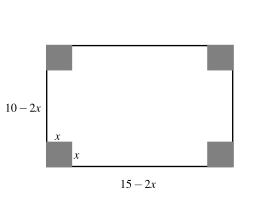
Draw a labeled diagram that shows the given information. What variable should we introduce to represent the choice we make in creating the box? Label the diagram appropriately with the variable, and write a sentence to state what the variable represents.
Hint.
Consider letting the length of one side of the removed squares be represented by \(x\text{.}\)
Answer.
Solution.
We let \(x\) represent the length of a side of the square that is cut from each corner, so that we have the following picture:
(b)
Determine a formula for the function \(V\) (that depends on the variable in (a)) that tells us the volume of the box.
Hint.
Remember that the volume of a box is length × width × height.
Answer.
\(V(x) = x (10-2x) (15-2x) = 4x^3 - 50x^2 + 150x\text{.}\)
Solution.
Because the box has dimensions \((10-2x) \times (15-2x) \times x\text{,}\) the volume of the box is given by
\begin{equation*}
V(x) = x (10-2x) (15-2x) = 4x^3 - 50x^2 + 150x\text{.}
\end{equation*}
(c)
What is the domain of the function \(V\text{?}\) That is, what values of \(x\) make sense for input? Are there additional restrictions provided in the problem?
Hint.
Read the given information carefully and think about the picture.
Answer.
\(1 \le x \le 3\text{.}\)
Solution.
Clearly the smallest \(x\) can be is 0 and the largest \(x\) can be is 5, since one side of the cardboard has length 10. But we’re told in the problem to restrict the value of \(x\) to \(1 \le x \le 3\text{,}\) so this is the domain we use for \(V\text{,}\) even though \(V\) is defined for every real number \(x\text{.}\)
(d)
Determine all critical numbers of the function \(V\text{.}\)
Hint.
Note that since \(V\) is a cubic function, \(V'\) is quadratic.
Answer.
\(x = \frac{25 \pm 5\sqrt{7}}{6} \approx 6.371459426, 1.961873908\text{.}\)
Solution.
Since \(V'(x) = 12x^2 - 100x + 150\text{,}\) it follows that the critical numbers (where \(V'(x) = 0\)) are
\begin{equation*}
x = \frac{25 \pm 5\sqrt{7}}{6} \approx 6.371459426, 1.961873908\text{.}
\end{equation*}
(e)
Evaluate \(V\) at each of the endpoints of the domain and at any critical numbers that lie in the domain.
Hint.
Which critical numbers satisfy \(1 \le x \le 3\text{?}\)
Answer.
-
\(\displaystyle V(1.961873908) = 132.0382370\)
-
\(\displaystyle V(1) = 104\)
-
\(\displaystyle V(3) = 108\)
Solution.
Only the latter critical number is in the relevant domain of \(V\text{,}\) and hence we consider
-
\(\displaystyle V(1.961873908) = 132.0382370\)
-
\(\displaystyle V(1) = 104\)
-
\(\displaystyle V(3) = 108\)
(f)
What is the maximum possible volume of the box? the minimum?
Hint.
Evaluate the function at appropriate points.
Answer.
Absolute maximum: 132.0382370; absolute minimum: 104.
Solution.
Hence the absolute maximum possible volume of the box is 132.0382370 and occurs when \(x = 1.961873908\text{,}\) while the absolute minimum is 104, which occurs when \(x=1\text{.}\)

