Handout Daily Prep 1.2 - The Notion of a Limit

Section Overview

We will now begin to investigate the idea of the limit of a function at a given input value. Limits are important in calculus for many reasons, but perhaps most important for how they allow us to formally connect instantaneous velocity to average velocity.
This section covers the following concepts: Definition and notation of limits. Graphical interpretation, table of values, algebraic computation. Indeterminate form of type \(0/0\text{.}\)

Section Basic learning objectives

These are the tasks you should be able to perform with reasonable fluency when you arrive at our next class meeting. Important new vocabulary words are indicated in italics.
  • State the two related formulas for the average velocity of an object with position function \(s\) on an interval \([a,b]\) and on the interval \([a,a+h]\text{.}\)
  • Interpret the meaning of notation such as β€œ\(\displaystyle \lim_{x\rightarrow 2}f(x) =-3\text{.}\)” Use limit notation.
  • Use computations of average velocity to determine instantaneous velocity.
  • Provide examples (both graphically and numerically) of functions that do not have a limit at a specific value.
  • Estimate/hypothesize the limit of a function at a point on a graph (or determine that it does not exist).

Section To prepare for class

Complete all actions listed below. Respond to the questions highlighted with Submit.
A single .pdf should be uploaded to D2L Brightspace. Strive to use valid notation and correct mathematical language and syntax. All answers should be briefly justified, whether justification is specifically requested or not.

Checkpoint 17. Limits versus Function Values.

Section After class

Solidifying the concepts discussed in class through practice is necessary to build your skills. Mathematics is not a spectator sport!

Section Advanced learning objectives

In addition to mastering the basic objectives, here are the tasks you should be able to perform after class, with practice:
  • Estimate the limit of a function at a point using the algebraic formula (or determine that it does not exist). This includes indeterminate forms of type \(0/0\text{.}\)

  • Compute instantaneous velocities using both formulas.
  • Demonstrate instantaneous velocity graphically on a position graph.
  • Explain how instantaneous velocity is thought of as a limit of average velocities.

Section Additional suggestions

Section Answers

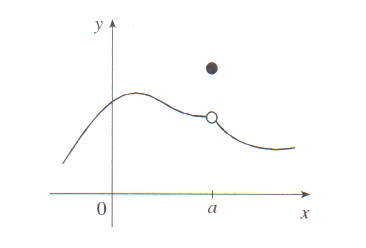
    1. True; the function is defined (as per black dot)
    2. True; the limits from the left and the right are the same
    3. True; however, these limits do not equal \(f(a)\)
  1. Answer will vary.
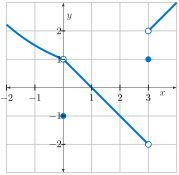
    Detailed graph of a piecewise-defined function on a square coordinate grid. The horizontal axis is labeled x and the vertical axis is labeled y, with integer tick marks shown. On the left side of the graph, for x less than 0, a smooth decreasing curve approaches the point (0, 1), ending at an open circle at (0, 1). At x = 0, the function instead has a filled point at (0, βˆ’1). From x = 0 to x = 3, the graph is a straight line with negative slope, starting at the open circle at (0, 1) and descending to an open circle at (3, βˆ’2). At x = 3, there is a filled point at (3, 1), distinct from the open points on the other pieces. For x greater than 3, the graph is a straight line with positive slope, beginning at an open circle at (3, 2) and increasing to the right. The graph emphasizes discontinuities at x = 0 and x = 3, shown by open circles and filled points at the same x-values but different y-values.
    Figure 18. One possible graph.
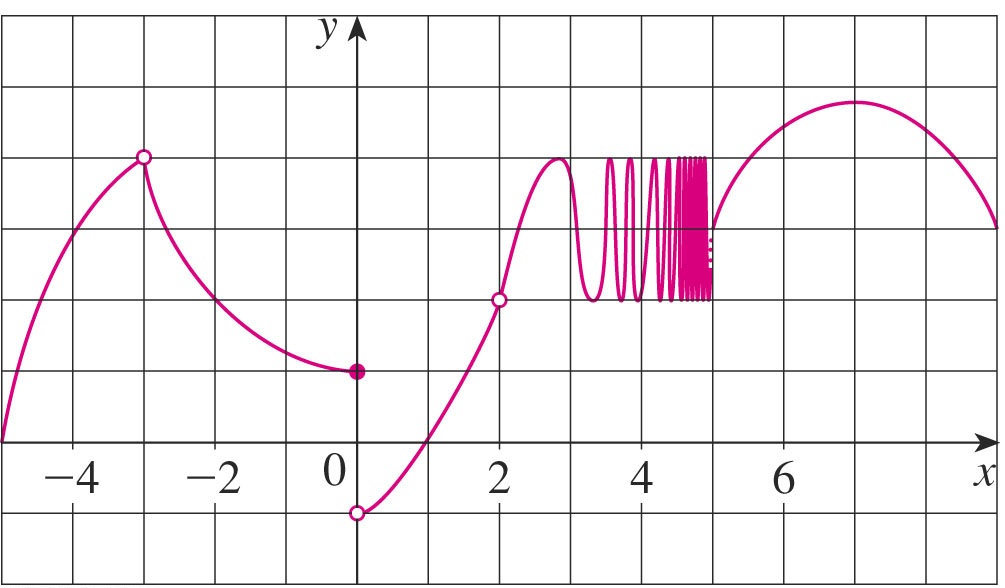
    1. \(\displaystyle \displaystyle \lim_{x \rightarrow -3^-}f(x) = 4\)
    2. \(\displaystyle \displaystyle \lim_{x \rightarrow -3^+}f(x) = 4\)
    3. \(\displaystyle \displaystyle \lim_{x \rightarrow -3}f(x) = 4\)
    4. \(f(-3)\) does not exist
    5. \(\displaystyle \displaystyle \lim_{x \rightarrow 0^-}f(x) = 1\)
    6. \(\displaystyle \displaystyle \lim_{x \rightarrow 0^+}f(x) = -1\)
    7. \(\displaystyle \lim_{x \rightarrow 0}f(x)\) does not exist
    8. \(\displaystyle f(0)= 1\)
    9. \(\displaystyle \displaystyle \lim_{x \rightarrow 2}f(x) = 2\)
    10. \(f(2)\) does not exist
    11. \(\displaystyle \displaystyle \lim_{x \rightarrow 5^+}f(x) = 3\)
    12. \(\displaystyle \lim_{x \rightarrow 5^-}f(x)\) does not exist