
Activity 19.
In this activity, we explore two different functions and classify the points at which each is not differentiable.
For (a)-(c), let \(g\) be the function given by the rule \(g(x) = |x|\text{.}\) Note that for part (d) we use the function \(f\) given by the graph in (d).
(a)
Reasoning graphically (that is, by discussing the graph of \(g(x)=|x|\)), explain why \(g\) is differentiable at every point \(x\) such that \(x \ne 0\text{.}\)
Hint.
What type of function is \(g\) for all \(x \lt 0\text{?}\) For all \(x > 0\text{?}\)
Answer.
\(g\) is piecewise linear.
Solution.
We know that \(g(x) = |x|\) is given by the formula \(g(x) = -x\) when \(x \lt 0\) and by \(g(x) = x\) when \(x \ge 0\text{.}\) Each of these pieces of \(g\) is a straight line, so at every point other than the point where they meet, the function \(g\) has a well-defined slope, and thus is differentiable.
(b)
Use the limit definition of the derivative to show that \(g'(0) = \lim_{h \to 0} \frac{|h|}{h}\text{.}\)
Hint.
Recall that \(g'(0) = \lim_{h \to 0} \frac{g(0 + h) - g(0)}{h}\text{.}\)
Answer.
\begin{align*}
g'(0) =\mathstrut \amp \lim_{h \to 0} \frac{g(0+h)-g(0)}{h}\\
=\mathstrut \amp \lim_{h \to 0} \frac{|0+h|-|0|}{h}\\
=\mathstrut \amp \lim_{h \to 0} \frac{|h|}{h}
\end{align*}
Solution.
Observe that
\begin{align*}
g'(0) =\mathstrut \amp \lim_{h \to 0} \frac{g(0+h)-g(0)}{h}\\
=\mathstrut \amp \lim_{h \to 0} \frac{|0+h|-|0|}{h}\\
=\mathstrut \amp \lim_{h \to 0} \frac{|h|}{h}
\end{align*}
(c)
Explain why \(g'(0)\) fails to exist by using small positive and negative values of \(h\text{.}\)
Hint.
What is the value of \(|h|\) when \(h \lt 0\text{?}\)
Answer.
\(\lim_{h \to 0^+} \frac{|h|}{h} = 1
\text{,}\) but \(\lim_{h \to 0^-} \frac{|h|}{h} = -1
\text{.}\)
Solution.
Following up on our work in (b), note that whenever \(h > 0\text{,}\) \(|h| = h\text{,}\) and thus
\begin{equation*}
\lim_{h \to 0^+} \frac{|h|}{h} = \lim_{h \to 0^+} \frac{h}{h} = 1\text{,}
\end{equation*}
while whenever \(h \lt 0\text{,}\) \(|h| = -h\text{,}\) and thus
\begin{equation*}
\lim_{h \to 0^-} \frac{|h|}{h} = \lim_{h \to 0^-} \frac{-h}{h} = -1
\end{equation*}
Since the right- and left-hand limits are not equal, it follows that
\begin{equation*}
g'(0) = \lim_{h \to 0} \frac{|h|}{h}
\end{equation*}
does not exist.
(d)
Let \(f\) be the function that we have previously explored in Preview Activity 1.7.1, whose graph is given again in the following figure.
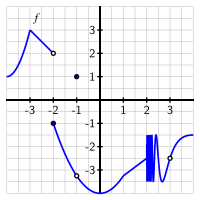
The graph from Preview Activity 1.7.1.
State all values of \(a\) for which \(f\) is not differentiable at \(x = a\text{.}\) For each, provide a reason for your conclusion.
Hint.
You might start by identifying points where \(f\) is not continuous.
Answer.
\(a = -3, -2, -1, 1, 2, 3\text{.}\)
Solution.
\(f\) is not differentiable at \(a = -2, -1, 2, 3\) because at each of these points \(f\) is not continuous. In addition, \(f\) is not differentiable at \(a = -3\) and \(a = 1\) because the graph of \(f\) has a corner point (or cusp) at each of these values.
(e)
True or false: if a function \(p\) is differentiable at \(x = b\text{,}\) then \(\lim_{x \to b} p(x)\) must exist. Why?
Hint.
What does being differentiable at a point tell you about continuity there?
Answer.
True.
Solution.
True: if a function \(p\) is differentiable at \(x = b\text{,}\) then \(\lim_{x \to b} p(x)\) must exist. This is true because we know that if \(p\) is differentiable at a point, then \(p\) is continuous there, and anytime a function is continuous at a point, it must have a limit there.

