
Activity 60.
Suppose that \(g\) is given by the graph at left in Figure 203 and that \(A\) is the corresponding integral function defined by \(A(x) = \int_1^x g(t) \, dt\text{.}\)
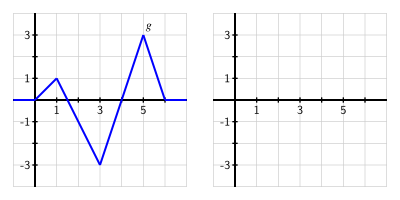
(a)
On what interval(s) is \(A\) an increasing function? On what intervals is \(A\) decreasing? Why?
Hint.
Where is \(A\) accumulating positive signed area?
Answer.
\(A\) is increasing on \((0,1.5)\text{,}\) \((4,6)\text{;}\) \(A\) is decreasing on \((1.5,4)\text{.}\)
Solution.
\(A\) is accumulating positive signed area wherever \(g\) is positive, and thus \(A\) is increasing on \((0,1.5)\text{,}\) \((4,6)\text{;}\) \(A\) is accumulating negative signed area and therefore decreasing wherever \(g\) is negative, which occurs on \((1.5,4)\text{.}\)
(b)
On what interval(s) do you think \(A\) is concave up? concave down? Why?
Hint.
As \(A\) accumulates positive or negative signed area, where is the rate at which such area is accumulated increasing?
Answer.
\(A\) is concave up on \((0,1)\) and \((3,5)\text{;}\) \(A\) is concave down on \((1,3)\) and \((5,6)\text{.}\)
Solution.
Here we want to consider where \(A\) is changing at an increasing rate (concave up) or changing at a decreasing rate (concave down). On \((0,1)\) and \((4,5)\text{,}\) \(A\) is increasing, and we can also see that since \(g\) is increasing, \(A\) is increasing at an increasing rate. Similarly, on \((3,4)\) (where \(g\) is negative so \(A\) is decreasing), since \(g\) is increasing it follows that \(A\) is decreasing at an increasing rate. Thus, \(A\) is concave up on \((0,1)\) and \((3,5)\text{.}\) Analogous reasoning shows that \(A\) is concave down on \((1,3)\) and \((5,6)\text{.}\)
(c)
At what point(s) does \(A\) have a relative minimum? a relative maximum?
Hint.
Where does \(A\) change from accumulating positive signed area to accumulating negative signed area?
Answer.
At \(x = 1.5\text{,}\) \(A\) has a relative maximum; \(A\) has a relative minimum at \(x = 4\text{.}\)
Solution.
Based on our work in (a), we see that \(A\) changes from increasing to decreasing at \(x = 1.5\text{,}\) and thus \(A\) has a relative maximum there. Similarly, \(A\) has a relative minimum at \(x = 4\text{.}\)
(d)
Use the given information to determine the exact values of \(A(0)\text{,}\) \(A(1)\text{,}\) \(A(2)\text{,}\) \(A(3)\text{,}\) \(A(4)\text{,}\) \(A(5)\text{,}\) and \(A(6)\text{.}\)
Hint.
Note, for instance, that \(A(2) = \int_1^2 g(t) \, dt\text{.}\)
Answer.
\(A(0) = -\frac{1}{2}\text{;}\) \(A(1) = 0\text{;}\) \(A(2) = 0\text{;}\) \(A(3) = -2\text{;}\) \(A(4) = -3.5\text{,}\) \(A(5) = -2\text{,}\) \(A(6) = -0.5\text{.}\)
Solution.
Using the fact that \(g\) is piecewise linear and the definition of \(A\text{,}\) we find that \(A(0) = \int_1^0 g(t) \, dt = -\int_0^1 g(t) \, dt = -\frac{1}{2}\text{;}\) \(A(1) = \int_1^1 g(t) \, dt = 0\text{;}\) \(A(2) = \int_1^2 g(t) \, dt = 0\text{.}\) Analogous reasoning shows that \(A(3) = -2\text{,}\) \(A(4) = -3.5\text{,}\) \(A(5) = -2\text{,}\) \(A(6) = -0.5\text{.}\)
(e)
Based on your responses to all of the preceding questions, sketch a complete and accurate graph of \(y = A(x)\) on the axes provided, being sure to indicate the behavior of \(A\) for \(x \lt 0\) and \(x \gt 6\text{.}\)
Hint.
Use your work in (a)-(d) appropriately.
Answer.
Use your work in (a)-(d) appropriately.
Solution.
Use your work in (a)-(d) appropriately.
(f)
How does the graph of \(B\) compare to \(A\) if \(B\) is instead defined by \(B(x) = \int_0^x g(t) \, dt\text{?}\)
Hint.
What is the value of \(B(0)\text{?}\) How does this compare to \(A(0)\text{?}\)
Answer.
\(B(x) = A(x) + \frac{1}{2}\text{.}\)
Solution.
Note that \(B(0) = 0\text{,}\) while \(A(0) = -\frac{1}{2}\text{.}\) Likewise, \(B(1) = \frac{1}{2}\text{,}\) while \(A(1) = 0\text{.}\) Indeed, we can see that for any value of \(x\text{,}\) \(B(x) = A(x) + \frac{1}{2}\text{.}\)

