
Activity 50.
A ball is tossed vertically in such a way that its velocity function is given by \(v(t) = 32 - 32t\text{,}\) where \(t\) is measured in seconds and \(v\) in feet per second. Assume that this function is valid for \(0 \le t \le 2\text{.}\)
(a)
For what values of \(t\) is the velocity of the ball positive? What does this tell you about the motion of the ball on this interval of time values?
Hint.
Where is velocity zero?
Answer.
On \((0,1)\text{,}\) \(s\) is increasing because velocity is positive.
Solution.
Note that \(v(1) = 0\) and for \(0 \lt t \lt 1\text{,}\) \(v(t) \gt 0\text{.}\) This means that on the interval \((0,1)\text{,}\) the position function \(s\) is increasing because velocity is positive.
(b)
Find an antiderivative, \(s\text{,}\) of \(v\) that satisfies \(s(0) = 0\text{.}\)
Hint.
Since \(v\) is linear, note that \(s\) must be quadratic.
Answer.
\(s(t) = 32t - 16t^2\text{.}\)
Solution.
We can check that the derivative of \(s(t) = 32t - 16t^2\) is \(s'(t) = v(t) = 32 - 32t\text{,}\) and that \(s(0) = 0\text{,}\) so this is the antiderivative of \(v\) that we desire.
(c)
Compute the value of \(s(1) - s(\frac{1}{2})\text{.}\) What is the meaning of the value you find?
Hint.
Observe that you are taking the difference between two values of the position function.
Answer.
\(s(1) - s(\frac{1}{2}) = 4\text{.}\)
Solution.
Now, \(s(1) - s(\frac{1}{2}) = (32 - 16) - (16 - 4) = 4\text{,}\) which is the change in position of the ball on the interval \([\frac{1}{2},1]\text{.}\) Equivalently, since \(v\) is positive through this interval, 4 feet is the vertical distance the ball traveled during this time.
(d)
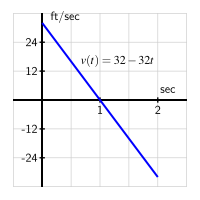
Using the graph of \(y = v(t)\) provided in Figure 186, find the exact area of the region between the velocity curve and the \(t\)-axis between \(t = \frac{1}{2}\) and \(t = 1\text{.}\) What is the meaning of the value you find?
Hint.
The region whose area is sought is triangular.
Answer.
\(A = 4\) feet is the total distance the ball traveled vertically on \([\frac{1}{2},1]\text{.}\)
Solution.
On the interval from \(t = \frac{1}{2}\) to \(t = 1\text{,}\) the corresponding area between the velocity curve and the \(t\)-axis is the area of the right triangular region whose width is \(\frac{1}{2}\) seconds and whose height is \(v(\frac{1}{2}) = 16\) feet/sec. That area is therefore \(A = \frac{1}{2} bh = \frac{1}{2} \cdot \frac{1}{2} \cdot 16 = 4\) feet. This is the total distance the ball traveled vertically on \([\frac{1}{2},1]\text{.}\)
(e)
Answer the same questions as in (c) and (d) but instead using the interval \([0,1]\text{.}\)
Hint.
See (c) and (d) above.
Answer.
\(s(1) - s(0) = 16\) is the vertical distance the ball traveled on the interval \([0,1]\text{.}\) Equivalently, the area between the velocity curve and the \(t\)-axis on \([0,1]\) is \(A = 16\) feet.
Solution.
\(s(1) - s(0) = (32 - 16) - (0-0) = 16\text{,}\) which is the vertical distance the ball traveled on the interval \([0,1]\text{.}\) The area between the velocity curve and the \(t\)-axis on \([0,1]\) is the area of the triangle with height 32 (ft/sec) and base 1 (second), which is \(A = \frac{1}{2} \cdot 1 \cdot 32 = 16\) feet. These two results are identical, in part due to the fact that we are using two different perspectives to compute the same quantity, which is distance traveled.
(f)
What is the value of \(s(2) - s(0)\text{?}\) What does this result tell you about the flight of the ball? How is this value connected to the provided graph of \(y = v(t)\text{?}\) Explain.
Hint.
What does it mean for the change of the ball’s position to be zero?
Answer.
\(s(2) - s(0) = 0\text{,}\) so the ball has zero change in position on the interval \([0,2]\text{.}\)
Solution.
Observe that \(s(2) - s(0) = (32 - 32) - (0 - 0) = 0\text{.}\) This means that the ball has zero change in position on the interval \([0,2]\text{.}\) But we already established that on the interval \([0,1]\text{,}\) the ball traveled 16 feet vertically; since the velocity becomes negative on the interval \(1 \lt t \lt 2\text{,}\) there we know the ball’s position is decreasing, so it is falling back to earth. The resulting zero change in position means that at \(t = 2\) the ball has returned to the location from which it was tossed. If we view the area between the velocity function and the \(t\)-axis as being negative wherever \(v\) is negative, then we see that the areas of the two triangles involved are opposites, which in some sense results in the “total area” being zero, matching the change in position.

