
Activity 46.
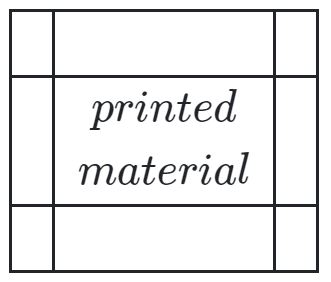
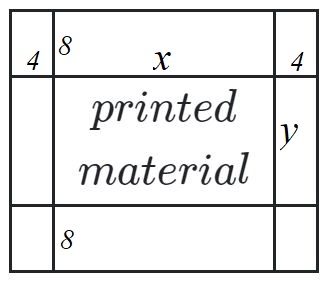
The top and bottom margins of a poster are 8 cm and the side margins are each 4 cm. The area of printed material on the poster is fixed at 200 square centimeters. Our goal will be to determine the dimensions of a poster that does this with minimum size.
(a)
Label the dimensions of the printed material on the poster in Figure 181 with variables \(x\) and \(y\text{.}\)
Answer.
(b)
Determine a formula \(A(x,y)\) for the area of the poster. Then, give a formula describing the constraint regarding printed material that must be satisfied when creating this poster.
Solution.
We seek to minimize \(A(x,y) = (x+8)(y+16) = xy+16x+8y+128\text{.}\) That could be made very small by, for example, choosing \(x=0\) and \(y=0\text{.}\) However, the constraint we face is that printed material must be 200 square centimeters. That is, \(xy=200\text{.}\)
(c)
Write the function \(A\) found in part (b) as a function of the single variable \(x\text{.}\) Over what domain should we consider this function?
Hint.
Solve \(xy=200\) for \(y\text{.}\)
Solution.
Solving \(xy=200\) gives \(\displaystyle y=\frac{200}{x}\text{.}\) Substituting this into \(A(x,y)\) gives
\begin{equation*}
A(x) = x\frac{200}{x}+16x+8\frac{200}{x}+128 = 16x + \frac{1600}{x}+ 328.
\end{equation*}
The domain of this function is \(0 < x < \infty\text{.}\) That is, in theory, we can choose \(x\) or \(y\) to be extremely small (but positive) and then the other variable would be quite large.
(d)
Find the dimensions of the poster with the smallest area.
Solution.
First, we find critical numbers. But \(A'(x) = 16 - 1600x^{-2}\) so that \(A'(x)=0\) exactly when \(16x^{2} = 1600\text{.}\) That is, when \(x=\pm 10\text{.}\) Since \(x=-10\) is not in the domain, only \(x=10\) is a critical number. To see that this is a global minimum, a first derivative sign chart can be drawn.


