
Activity 42.
Suppose that \(g(x)\) is a function whose first derivative is
\begin{equation*}
g'(x) = \frac{(x+4)(x-2)}{x^2+1}\text{.}
\end{equation*}
(a)
Determine, with justification, all critical numbers of \(g\text{.}\)
Hint.
Where is \(g'(x) = 0\text{?}\) Is there anywhere that \(g'(x)\) is undefined?
Answer.
\(x = -4\) and \(x = 2\) are the only two critical numbers of \(g\text{.}\)
Solution.
Using the given fact that \(g'(x) = \frac{(x+4)(x-2)}{x^2+1}\text{,}\) we observe that since \(x^2 + 1\) is never 0, \(g'(x)\) is never undefined. Moreover, \(g'(x) = 0\) implies that \((x+4)(x-2) = 0\text{,}\) which only happens when \(x = -4\) or \(x = 2\text{,}\) so these are the two critical numbers of \(g\text{.}\)
(b)
By developing a carefully labeled first derivative sign chart, decide whether \(g\) has as a local maximum, local minimum, or neither at each critical number.
Hint.
Choose values of \(x\) that lie just before and/or just after each of the critical numbers, and find the sign of \(g'(x)\) at each of them.
Answer.
For \(x \lt -4\text{,}\) \(g'(x) \gt 0\text{;}\) for \(-4 \lt x \lt 2\text{,}\) \(g'(x) \lt 0\text{;}\) and for \(x \gt 2\text{,}\) \(g'(x) \gt 0\text{.}\)
Solution.
We can observe that for \(x \lt -4\text{,}\) \(g'(x) \gt 0\text{;}\) for \(-4 \lt x \lt 2\text{,}\) \(g'(x) \lt 0\text{;}\) and for \(x \gt 2\text{,}\) \(g'(x) \gt 0\text{.}\)
(c)
Does \(g\) have a global maximum? global minimum? Justify your claims.
Hint.
Are there \(x\)-values where \(g'(x)\) changes from negative to positive? positive to negative?
Answer.
\(g\) has a local maximum at \(x = -4\text{;}\) \(g\) has a local minimum at \(x = 2\text{.}\)
Solution.
Using the First Derivative Test and the signs of \(g'(x)\) we found in (b), it follows \(g\) has a local maximum at \(x = -4\text{,}\) since at that value \(g'(x)\) changes from positive to negative; similarly, \(g\) has a local minimum at \(x = 2\) since there the derivative changes from negative to positive.
(d)
Sketch a possible graph of \(y = g(x)\text{.}\) Clearly label any local or global extrema on the graph.
Hint.
Think about where \(g\) is increasing and decreasing, as well as where \(g\) has relative extremes.
Answer.
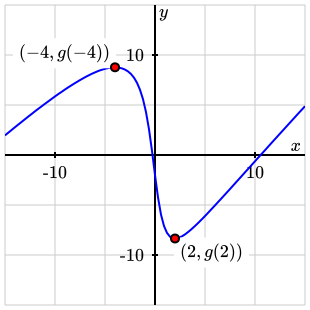
A plot of a possible function \(y = g(x)\) whose derivative is the given formula for \(g'(x)\text{.}\)
Solution.
By thinking about where \(g\) is increasing and decreasing, as well as where \(g\) has local extremes, we can sketch the following possible graph of \(g\text{.}\)
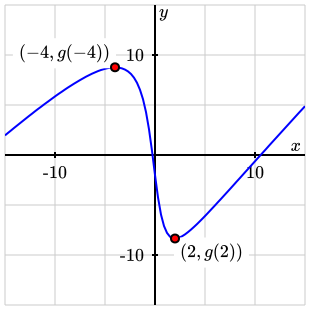
A plot of a possible function \(y = g(x)\) whose derivative is the given formula for \(g'(x)\text{.}\)
Note that any vertical shift of \(g\) will have the same shape and same derivative, so multiple graphs are possible. In addition, we can observe that as \(x \to \pm \infty\text{,}\) \(g'(x) \to 1\text{,}\) and this explains why our graph looks linear in its end behavior in each direction.

