
Activity 40.
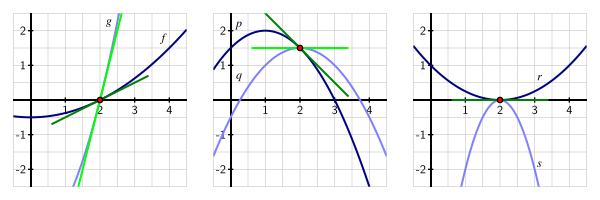
In this activity, we reason graphically from the following figure to evaluate limits of ratios of functions about which some information is known.
(a)
Use the left-hand graph to determine the values of \(f(2)\text{,}\) \(f'(2)\text{,}\) \(g(2)\text{,}\) and \(g'(2)\text{.}\) Then, evaluate \(\lim\limits_{x \to 2} \frac{f(x)}{g(x)}\text{.}\)
Hint.
Don’t forget that \(f'(a)\) measures the slope of the tangent line to \(y = f(x)\) at the point \((a,f(a))\text{.}\)
Answer.
\(\lim_{x \to 2} \frac{f(x)}{g(x)} = \frac{1}{8}\text{.}\)
Solution.
From the given graph, we observe that \(f(2) = 0\text{,}\) \(f'(2) = \frac{1}{2}\text{,}\) \(g(2)=0\text{,}\) and \(g'(2) = 4\text{.}\) By L’Hôpital’s Rule,
\begin{equation*}
\lim_{x \to 2} \frac{f(x)}{g(x)} = \frac{f'(2)}{g'(2)} = \frac{\frac{1}{2}}{4} = \frac{1}{8}\text{.}
\end{equation*}
(b)
Use the middle graph to find \(p(2)\text{,}\) \(p'(2)\text{,}\) \(q(2)\text{,}\) and \(q'(2)\text{.}\) Then, determine the value of \(\lim\limits_{x \to 2} \frac{p(x)}{q(x)}\text{.}\)
Hint.
Do the functions \(p\) and \(q\) meet the criteria of L’Hôpital’s Rule?
Answer.
\(\lim_{x \to 2} \frac{p(x)}{q(x)} = 1\text{.}\)
Solution.
The given graph tells us that \(p(2) = 1.5\text{,}\) \(p'(2)=-1\text{,}\) \(q(2)=1.5\text{,}\) and \(q'(2)=0\text{.}\) Note well that the given limit,
\begin{equation*}
\lim_{x \to 2} \frac{p(x)}{q(x)}\text{,}
\end{equation*}
is not indeterminate, and thus L’Hôpital’s Rule does not apply. Rather, since \(p(x) \to 1.5\) and \(q(x) \to 1.5\) as \(x \to 2\text{,}\) we have that
\begin{equation*}
\lim_{x \to 2} \frac{p(x)}{q(x)} = \frac{p(2)}{q(2)} = \frac{1.5}{1.5} = 1\text{.}
\end{equation*}
(c)
Assume that \(r\) and \(s\) are functions whose for which \(r''(2) \ne 0\) and \(s''(2) \ne 0\) Use the right-hand graph to compute \(r(2)\text{,}\) \(r'(2)\text{,}\) \(s(2)\text{,}\) \(s'(2)\text{.}\) Explain why you cannot determine the exact value of \(\lim\limits_{x \to 2} \frac{r(x)}{s(x)}\) without further information being provided, but that you can determine the sign of \(\lim\limits_{x \to 2} \frac{r(x)}{s(x)}\text{.}\) In addition, state what the sign of the limit will be, with justification.
Hint.
Remember that L’Hôpital’s Rule can be applied more than once to a particular limit.
Answer.
\(\lim_{x \to 2} \frac{r(x)}{s(x)} \lt 0\text{.}\)
Solution.
From the third graph, \(r(2)=0\text{,}\) \(r'(2)=0\text{,}\) \(s(2)=0\text{,}\) \(s'(2)=0\text{.}\) By L’Hôpital’s Rule,
\begin{equation*}
\lim_{x \to 2} \frac{r(x)}{s(x)} = \lim_{x \to 2} \frac{r'(x)}{s'(x)}\text{,}
\end{equation*}
but this limit is still indeterminate, so by L’Hôpital’s Rule again,
\begin{equation*}
\lim_{x \to 2} \frac{r(x)}{s(x)} = \lim_{x \to 2} \frac{r''(x)}{s''(x)} = \frac{r''(2)}{s''(2)}\text{,}
\end{equation*}
provided that \(s''(2) \ne 0\text{.}\) Since we do not know the values of \(r''(2)\) and \(s''(2)\text{,}\) we can’t determine the actual value of the limit, but from the graph it appears that \(r''(2) \gt 0\) (since \(r\) is concave up) and that \(s''(2) \lt 0\) (because \(s\) is concave down), and therefore
\begin{equation*}
\lim_{x \to 2} \frac{r(x)}{s(x)} \lt 0\text{.}
\end{equation*}

