
Activity 38.
As pictured in the interactive graphic, a skateboarder who is 6 feet tall rides under a 15 foot tall lamppost at a constant rate of 3 feet per second. We are interested in understanding how fast his shadow is changing at various points in time.
(a)
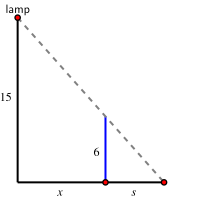
Draw an appropriate right triangle that represents a snapshot in time of the skateboarder, lamppost, and his shadow. Let \(x\) denote the horizontal distance from the base of the lamppost to the skateboarder and \(s\) represent the length of his shadow. Label these quantities, as well as the skateboarder’s height and the lamppost’s height on the diagram.
Hint.
Note that the lengths of the legs of the right triangle will be \(15\) for the vertical one and \(x + s\) for the horizontal one.
Answer.
Solution.
The given information leads us to construct the following diagram:
(b)
Observe that the skateboarder and the lamppost represent parallel line segments in the diagram, and thus similar triangles are present. Use similar triangles to establish an equation that relates \(x\) and \(s\text{.}\)
Hint.
The small triangle formed by the skateboarder and his shadow, with legs \(6\) and \(s\) is similar to the large triangle that has the lamppost as one of its legs.
Answer.
\(3s = 2x\text{.}\)
Solution.
The small triangle formed by the skateboarder and his shadow, with legs of length \(6\) and \(s\) is similar to the large triangle that has the lamppost as one of its legs (length 15) and horizontal leg of length \(x + s\text{.}\) Because the ratios of the lengths of the legs of these two triangles is equal, we have
\begin{equation*}
\frac{s}{6} = \frac{s+x}{15}\text{.}
\end{equation*}
Simplifying, we have \(15s = 6s + 6x\text{,}\) so that \(9s = 2x\text{,}\) or most simply, \(3s = 2x\text{.}\)
(c)
Use your work in (b) to find an equation that relates \(\frac{dx}{dt}\) and \(\frac{ds}{dt}\text{.}\)
Hint.
Simplify the equation in (b) as much as possible before differentiating implicitly with respect to \(t\text{.}\)
Answer.
\(3 \frac{ds}{dt} = 2\frac{dx}{dt}\text{.}\)
Solution.
Differentiating with respect to \(t\text{,}\) it is immediate that \(3 \frac{ds}{dt} = 2\frac{dx}{dt}\text{.}\)
(d)
At what rate is the length of the skateboarder’s shadow increasing at the instant the skateboarder is 8 feet from the lamppost?
Hint.
Find \(\left. \frac{ds}{dt} \right|_{x=8}\text{.}\)
Answer.
\(\left. \frac{ds}{dt} \right|_{x=8} = 2\) feet per second.
Solution.
Since \(\frac{ds}{dt} = \frac{2}{3} \frac{dx}{dt}\text{,}\) and \(\frac{dx}{dt} = 3\text{,}\) it follows \(\frac{ds}{dt} = 2\) for every value of \(t\) (and \(x\)). Thus, \(\left. \frac{ds}{dt} \right|_{x=8} = 2\) feet per second.
(e)
As the skateboarder’s distance from the lamppost increases, is his shadow’s length increasing at an increasing rate, increasing at a decreasing rate, or increasing at a constant rate?
Hint.
Does the equation that relates \(\frac{dx}{dt}\) and \(\frac{ds}{dt}\) involve \(x\text{?}\) Is \(\frac{dx}{dt}\) changing or constant?
Answer.
at a constant rate.
Solution.
Because \(\frac{ds}{dt}\) is constant, the shadow’s length is increasing at a constant rate (irrespective of the distance from the skateboarder to the lamppost).
(f)
Which is moving more rapidly: the skateboarder or the tip of his shadow? Explain, and justify your answer.
Hint.
Let \(y\) represent the location of the tip of the shadow, so that \(y = x + s\text{.}\)
Answer.
Let \(y\) represent the location of the tip of the shadow; \(\frac{dy}{dt} = 5\) feet/sec.
Solution.
Let \(y\) represent the location of the tip of the shadow, so that \(y = x + s\text{.}\) Observe that we can now compute \(\frac{dy}{dt}\) in terms of \(\frac{dx}{dt}\) and \(\frac{ds}{dt}\text{,}\) with \(\frac{dy}{dt} = \frac{dx}{dt} + \frac{ds}{dt} = 3 + 2 = 5\) feet/sec, and hence the tip of the shadow is moving more rapidly than the skateboarder himself.

