
Activity 37.
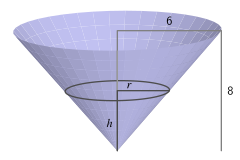
A water tank has the shape of an inverted circular cone (point down) with a base of radius 6 feet and a depth of 8 feet. Suppose that water is being pumped into the tank at a constant instantaneous rate of 4 cubic feet per minute.
(a)
Draw a picture of the conical tank that show the water level at a point in time when the tank is not yet full. Introduce variables that measure the radius of the water’s surface and the water’s depth in the tank, and label them on your figure.
Answer.
Solution.
Letting \(r\) represent the water’s radius at time \(t\) and \(h\) the water’s depth, we see the following situation:
(b)
Say that \(r\) is the radius and \(h\) the depth of the water at a given time, \(t\text{.}\) What equation relates the radius and height of the water, and why?
Hint.
Think about similar triangles.
Answer.
\(r = \frac{3}{4}h\text{.}\)
Solution.
Observe that the right triangle with legs of length \(h\) and \(r\) is similar to the right triangle with legs of length \(8\) and \(6\text{,}\) respectively, based on how the water assumes the shape of the tank, and thus \(\frac{r}{h} = \frac{6}{8}\text{,}\) so that \(r = \frac{3}{4}h\text{.}\)
(c)
Determine an equation that relates the volume of water in the tank at time \(t\) to the depth \(h\) of the water at that time.
Hint.
Recall that the volume of a cone is \(V = \frac{1}{3} \pi r^2 h\text{.}\)
Answer.
\(V = \frac{3}{16} \pi h^3\text{.}\)
Solution.
Since the water in the tank always takes the shape of a circular cone, the volume of water in the tank at time \(t\) is given by \(V = \frac{1}{3}\pi r^2 h\text{.}\) Because we have established that \(r = \frac{3}{4}h\text{,}\) it follows that
\begin{equation*}
V = \frac{1}{3}\pi \left( \frac{3}{4}h \right)^2 h = \frac{3}{16} \pi h^3\text{.}
\end{equation*}
(d)
Through differentiation, find an equation that relates the instantaneous rate of change of water volume with respect to time to the instantaneous rate of change of water depth at time \(t\text{.}\)
Hint.
Remember to differentiate implicitly with respect to \(t\text{.}\)
Answer.
\(\frac{dV}{dt} = \frac{9}{16} \pi h^2 \frac{dh}{dt} \text{.}\)
Solution.
Differentiating with respect to \(t\text{,}\) we now find
\begin{equation*}
\frac{dV}{dt} = \frac{9}{16} \pi h^2 \frac{dh}{dt}\text{,}
\end{equation*}
which relates the rates of change of \(V\) and \(h\text{.}\)
(e)
Find the instantaneous rate at which the water level is rising when the water in the tank is 3 feet deep.
Hint.
Use \(h = 3\) and the fact that the value of \(\frac{dV}{dt}\) is given.
Answer.
\(\left. \frac{dh}{dt} \right|_{h=3} = \frac{64}{81\pi} \approx 0.2515\) feet per minute.
Solution.
It is given in the problem setting that water is entering the tank at a rate of 4 cubic feet per minute, hence \(\frac{dV}{dt} = 4\text{,}\) and we are interested in the rate of change of the water’s depth when \(h = 3\text{.}\) Substituting these values into the equation that relates \(\frac{dV}{dt}\) and \(\frac{dh}{dt}\text{,}\) we find that
\begin{equation*}
4 = \frac{9}{16} \pi 3^2 \left. \frac{dh}{dt} \right|_{h=3}\text{,}
\end{equation*}
so that \(\left. \frac{dh}{dt} \right|_{h=3} = \frac{64}{81\pi} \approx 0.2515\) feet per minute.
(f)
When is the water rising most rapidly: at \(h = 3\text{,}\) \(h = 4\text{,}\) or \(h = 5\text{?}\) Why?
Answer.
Most rapidly when \(h = 3\text{.}\)
Solution.
Having established that
\begin{equation*}
\frac{dV}{dt} = \frac{9}{16} \pi h^2 \frac{dh}{dt}\text{,}
\end{equation*}
using \(\frac{dV}{dt} = 4\) and solving for \(\frac{dh}{dt}\text{,}\) we have
\begin{equation*}
\frac{dh}{dt} = \frac{4}{\frac{9}{16} \pi h^2}\text{.}
\end{equation*}
This relationship between \(\frac{dh}{dt}\) and \(h\) shows that as \(h\) increases, \(\frac{dh}{dt}\) decreases. Thus, the water (which enters the tank at a constant rate) is rising most rapidly when \(h = 3\text{,}\) and this matches our intuition for how the water should rise in the conical tank: quickly at first, and then ever more slowly as time progresses.

