
Activity 28.
The purpose of this activity is to confidently produce the derivative of the secant function by hypothesizing its properties, deriving its formula algebraically, and then looking back to see if our answer is reasonable.
(a)
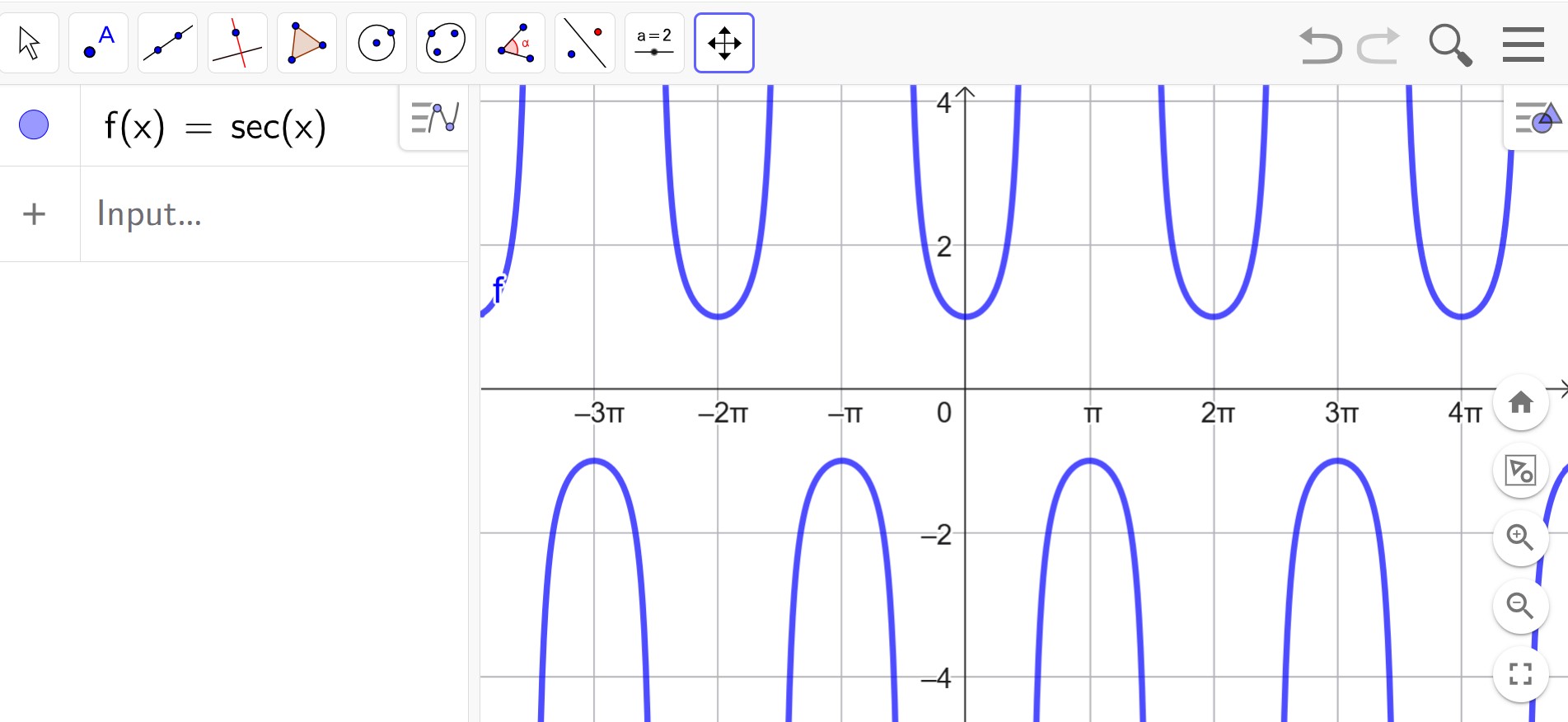
Using GeoGebra, graph \(f(x) = \sec x\text{.}\) GeoGebra can be found by “googling” the phrase “GeoGebra classic”.
Answer.
(b)
-
Is \(f(x) = \sec x\) continuous?
-
True or False: We expect \(f'(x)\) to be continuous. Defend your response.
Hint.
Remember that the derivative is slope.
Answer.
-
No.
-
False. \(\sec(x)\) is not continuous so we should not expect its derivative to be continuous either.
(c)
-
\(f(x) = \sec x\) is periodic. What is its period?
-
True or False: We expect \(f'(x)\) to be periodic. Defend your response.
-
At various \(x\)-values, we expect \(f'(x) = 0\text{.}\) In fact, we expect this to happen periodically. How often should we expect \(f'(x)=0\text{?}\)
Hint.
This of period as the length of the motif.
Answer.
-
\(\displaystyle 2\pi\)
-
True. The slope is periodic if the function is periodic.
-
Every \(\pi\) units.
(d)
-
Between \(-\pi/2\) and \(\pi/2\text{,}\) do we expect \(f'(x)\) to be increasing or decreasing? Why?
-
Between \(\pi/2\) and \(3\pi/2\text{,}\) do we expect \(f'(x)\) to be increasing or decreasing? Why?
Hint.
Think about the slope.
Answer.
-
Increasing. \(\sec(x)\) is concave up.
-
Decreasing. \(\sec(x)\) is concave down.
(e)
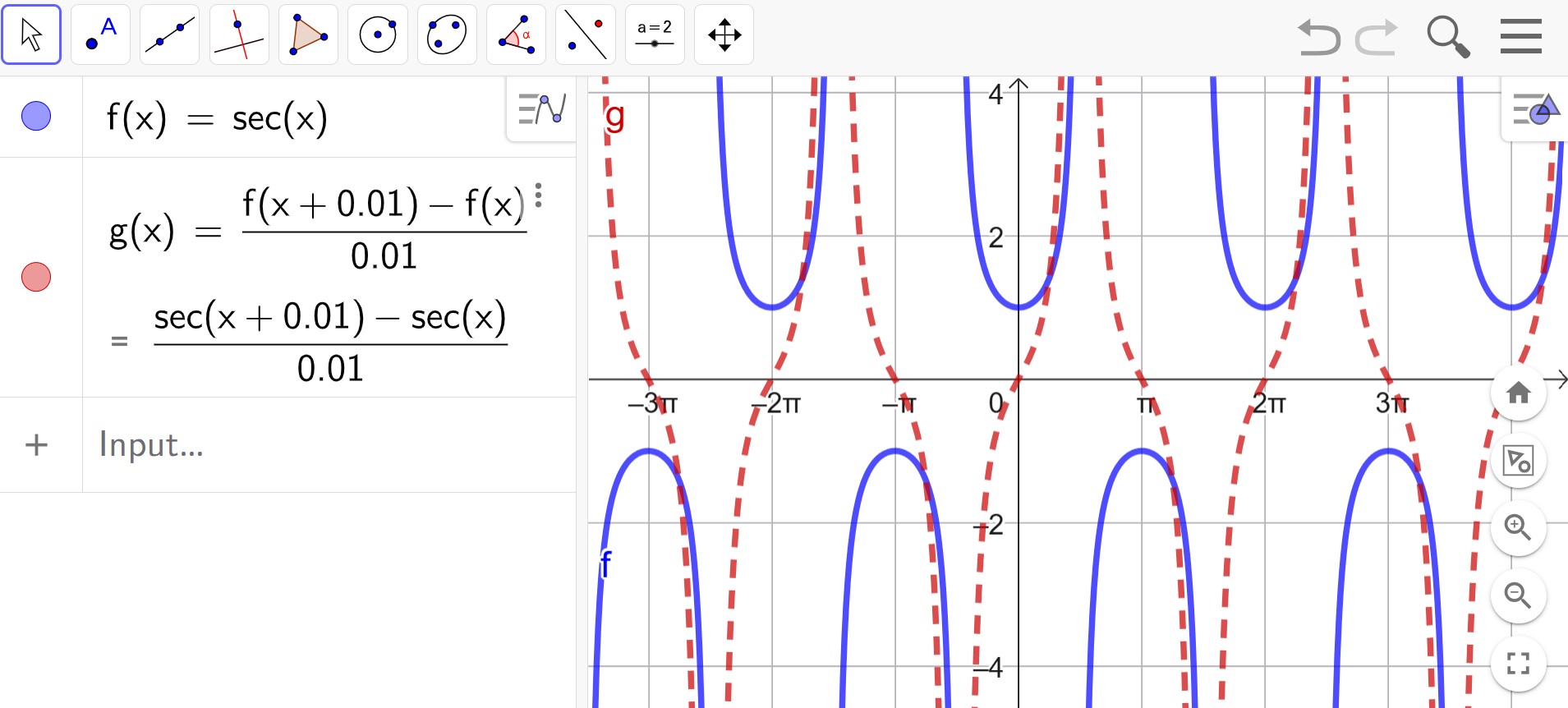
In GeoGebra, use the second input box to estimate \(f'(x)\) by typing the expression \(\displaystyle \frac{f(x+0.01)-f(x)}{0.01}\text{.}\) GeoGebra will label this as \(g(x)\) and plot it for you. Does the estimated graph of \(f'(x)\) found in this manner appear to have all of the properties guessed in parts (b)-(d)? If not, which ones does it fail to have?
Answer.
Yes, it has all of the expected properties.
(f)
Using the quotient rule, compute \(f'(x)\) if \(f(x) = \sec x\text{.}\) Use trigonometric identities to simplify your result.
Hint.
\(\displaystyle \sec(x) = \frac{1}{\cos(x)}\)
Answer.
\begin{align*}
\displaystyle \frac{d}{dx}\left( \frac{1}{\cos(x)} \right) = \amp \mathstrut \frac{ (\cos(x))(0)-(1)(-\sin(x))}{\cos^2(x)} \\
= \amp \mathstrut \frac{\sin(x)}{\cos^2(x)} \\
= \amp \mathstrut \tan(x)\sec(x)
\end{align*}
(g)
In the third box in GeoGebra, enter the formula for \(f'(x)\) you found above. Does the graph GeoGebra produces appear to be similar to the estimate you produced in part (e)? Should it?
Answer.
Yes and yes.

