
Activity 11.
(a)
Hint.
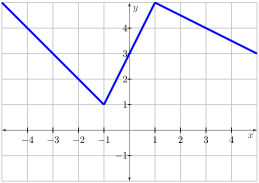
What is the slope of the function at every point?
Answer.
(b)
Determine values of \(f(3)\) and \(f'(3)\) from the graph of \(f(x)\) (if they exist).
Answer.
\(f(3)=3\) and \(f'(3)=-0.5\text{.}\)
(c)
Do you think \(f'(1)\) exists? Defend your answer.
Answer.
It does not exist since the slope radically changes at \(x=1\text{.}\)
(d)
Compare the values of \(\displaystyle \lim_{h \rightarrow 0^-} \frac{f(1+h)-f(1)}{h}\) and \(\displaystyle \lim_{h \rightarrow 0^+} \frac{f(1+h)-f(1)}{h}\text{.}\) What does this tell us?
Hint.
To the left of \(x=1\text{,}\) what is the slope of the function? To the right of \(x=1\text{?,}\) what is this slope?
Answer.
\(\displaystyle \lim_{h \rightarrow 0^-} \frac{f(1+h)-f(1)}{h} = 2\) and \(\displaystyle \lim_{h \rightarrow 0^+} \frac{f(1+h)-f(1)}{h} = -0.5\text{.}\) Since these values are different, the two-sided limit \(\displaystyle \lim_{h \rightarrow 0} \frac{f(1+h)-f(1)}{h}\) which represents \(f'(1)\) does not exist.
(e)
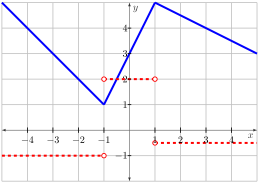
Write a piecewise function describing \(f'(x)\text{.}\)
Answer.
\(f'(x) = \begin{cases} -1 {\textrm{ if }} -5 < x < -1 \\ 2 {\textrm{ if }} -1 < x < 1 \\ -0.5 {\textrm{ if }} 1 < x < 5 \end{cases}\)
(f)
Does \(f\) or \(f'\) have a larger domain? Will this always be true? Why or why not?
Hint.
What is the domain of \(f'\text{?}\)
Answer.
The domain of \(f\) is \([-5,5]\text{.}\) The domain of \(f'\) is \([-5,-1) \cup (-1,1) \cup (1,5] \text{.}\) So \(f\) has the larger domain. This will always be true since the derivative does not exist if the function is not defined at a given point.

