Handout Exam 2 - Fall 2025

Section Topics

1.8-2.7
Be sure to try each question before looking at the solutions.

Exercises Questions

1.

Let \(f\) be a differentiable and strictly increasing function such that
\begin{equation*} f(2)=5 \ \ \ \ {\text{and}}\ \ \ \ f'(2)=4. \end{equation*}
Let \(g=f^{-1}\) be the inverse of \(f\) .
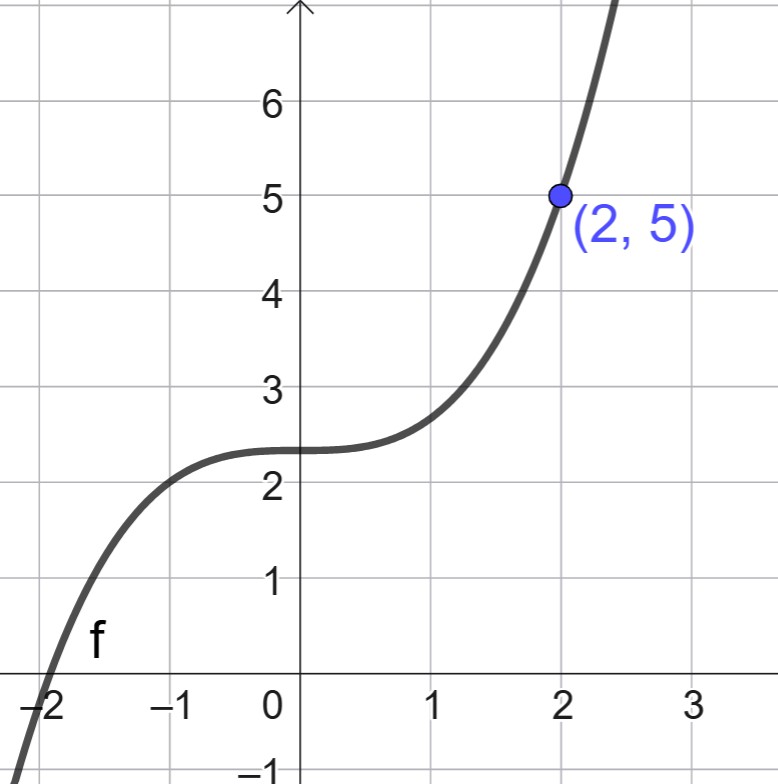
Graph of an increasing S-shaped curve labeled f, passing through the point (2,5) dashed guide lines connect the point to the axes, showing x=2 and y=5.
Figure 235. A graph of \(f(x)\text{.}\)
  1. Compute \(g'(5)\) .
  2. Find the equation of the tangent line to the graph of \(g(x)\) at the point \((5,2)\) .
Answer.
  1. \(\displaystyle \displaystyle g'(5)= \frac{1}{f'(2)} = \frac{1}{4}\)
  2. \(\displaystyle \displaystyle y-2=\frac{1}{4}(x-5)\)
2.

A computer system processes data at a rate that depends on the number of users \(u(t)\) and the average data processed per user \(p(t)\text{,}\) both changing over time \(t\) (measured in minutes). The total data processed at time \(t\) is
\begin{equation*} T(t) = u(t) \cdot p(t). \end{equation*}
At time \(t=5\) minutes, the number of users is 200 and is increasing at a rate of 12 users per minute. At the same time (\(t=5\) minutes), the average data processed per users is 3.5 MB/min and is increasing at a rate of 0.2 MB/min\(^{2}\text{.}\)
Compute the rate of change of total data processed \(T\) at \(t=5\) minutes. Be sure to include appropriate units in your response.
Answer.
We have
\begin{equation*} T'(t) = u'(t)\cdot p(t) + u(t) \cdot p'(t) \end{equation*}
where \(u(5)=200\text{,}\) \(u'(5)=12\text{,}\) \(p(5)=3.5\text{,}\) and \(p'(5)=0.2\text{.}\) So,
\begin{align*} T'(5) \mathstrut \amp = u'(5)p(5) + u(5)p'(5) \\ \amp \left( 12 \ \frac{users}{min}\right) \left( 3.5 \ \frac{MB}{min}\right) + \left( 200 \ users \right)\left( 0.2 \ \frac{MB}{min^2}\right) \\ \amp 82 \ \frac{MB}{min^2} \end{align*}

3.

Suppose \(f\) and \(g\) are differentiable functions with the values shown in TableΒ 236.
Table 236. Values of \(f(x)\text{,}\) \(g(x)\text{,}\) \(f'(x)\text{,}\) and \(g'(x)\) at various values of \(x\text{.}\)
  1. Find \(h'(1)\) if \(\displaystyle h(x)=x^{3}g(x)\) .
  2. Find the exact value of \(m'(0)\) if \(\displaystyle m(x)=\frac{e^{f(x)}}{g(x)}\) .
  3. Find the exact value of \(p'(2)\) if \(\displaystyle p(x) = 4\ln(x) - \cos(g(x))\) .
Answer.
  1. Use the product rule:
    \begin{equation*} h'(x) = 3x^2 g(x) + x^3 g'(x). \end{equation*}
    It follows that
    \begin{align*} h'(1) \amp = 3(1)^2g(1) + (1)^3g'(1) \\ \amp = 3(-3)+6 \\ \amp = -3 \end{align*}
  2. By the quotient rule,
    \begin{equation*} m'(x) = \frac{g(x) \frac{d}{dx}\left( e^{f(x)} \right) - e^{f(x)}\frac{d}{dx}\left( g(x) \right)}{g(x)^2} \end{equation*}
    So,
    \begin{align*} m'(0) \mathstrut \amp = \frac{g(0)f'(0)e^{f(0)} - e^{f(0)}g'(0)}{g(0)^2} \\ \amp = \frac{(2)(9)(e^5) - e^5(-3)}{2^2} \\ \amp = \frac{21e^5}{4} \end{align*}
  3. By the constant multiple and chain rules, we have
    \begin{equation*} p'(x) = 4 \cdot \frac{1}{x} + g'(x) \sin(g(x)). \end{equation*}
    So,
    \begin{align*} p'(2) \mathstrut \amp = \frac{4}{2} + g'(2)\sin(g(2)) \\ \amp = 2+ 1\sin(3) \\ \amp = 2 + \sin(3) \end{align*}

4.

The function \(f(x)=x2^{x}\) is decreasing on \((-\infty,c)\) and increasing on \((c,\infty)\) . What is the exact value of \(c\) . Explain how you determined this value.
Answer.
\begin{equation*} f'(x) = 1 \cdot 2^x + x(\ln 2)(2^x) = 0 \end{equation*}
if and only if
\begin{equation*} 2^x (1+(\ln 2)x) = 0 \end{equation*}
if and only if
\begin{equation*} 1 + (\ln 2)x=0 \end{equation*}
if and only if
\begin{equation*} x = -\frac{1}{\ln 2} \end{equation*}
So, \(\displaystyle c = -\frac{1}{\ln 2}\text{.}\) The derivative \(f'\) changes from negative to positive here.

5.

Find the equation of the tangent line to the curve \(\displaystyle \ln(x+y^{2}) = xy\) at the ordered pair \((1,0)\) .
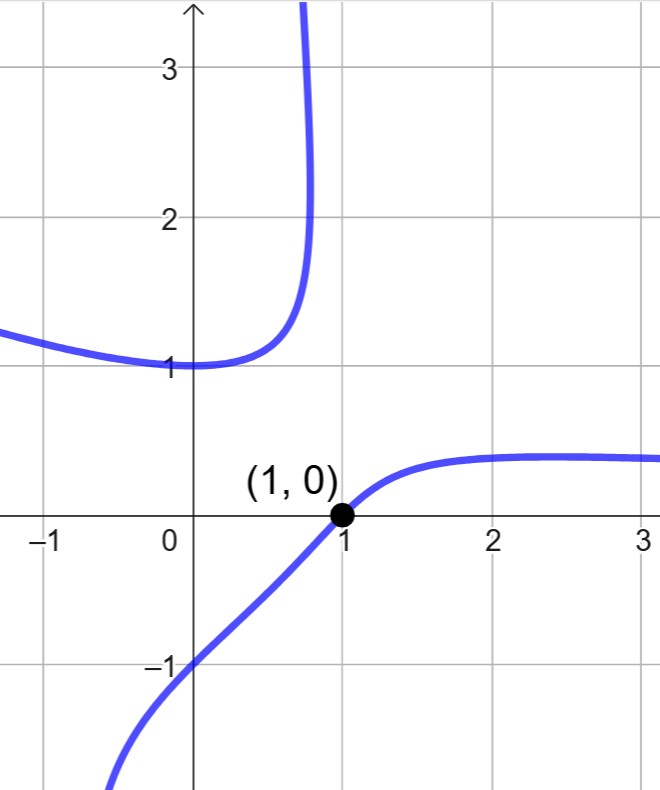
Graph with two branches and a vertical asymptote; the lower branch passes through the labeled point (1, 0), while the upper branch approaches the asymptote from the left.
Figure 237. A graph of \(\ln(x+y^2) = xy\) and the ordered pair \((1,0)\text{.}\)
Answer.
\begin{align*} \frac{d}{dx} \ln(x+y^2) \mathstrut \amp = \frac{d}{dx}(xy) \\ \implies \frac{1}{x+y^2} [1+2y\frac{dy}{dx}] \amp = 1\cdot y + x\frac{dy}{dx} \\ \implies \frac{1}{x+y^2} + \frac{2y}{x+y^2} \frac{dy}{dx} \amp = y + x\frac{dy}{dx} \\ \implies \left( \frac{2y}{x+y^2}-x\right) \frac{dy}{dx} \amp = y- \frac{1}{x+y^2} \end{align*}
So,
\begin{equation*} \frac{dy}{dx} = \frac{y-\frac{1}{x+y^2}}{\frac{2y}{x+y^2}-x} \end{equation*}
and evaluating this at \(x=1\) and \(y=0\) gives 1 (the slope of the tangent line at \((1,0)\)). So the tangent line is
\begin{equation*} y-0 = 1(x-1). \end{equation*}

6.

A metal object is cooling in a 20 \(^{\circ}C\) room. The temperature (in \(^{\circ}C\) ) of the object at time \(t\) (in minutes) is \(T(t)\) and its volume \(V\) (in cm \(^{3}\) ) depends on temperature \(T\) (in \(^{\circ}C\) ) according to
\begin{equation*} V(T)=1000+0.2T. \end{equation*}
The temperature of the object follows Newton’s Law of Cooling:
\begin{equation*} \frac{dT}{dt}= -0.1(T-20). \end{equation*}
If the temperature of the object at time \(t=0\) is \(T(0)=80^{\circ}C\text{,}\) use the chain rule to compute the rate of change in the object’s volume at \(t=0\text{.}\)
Answer.
We find
\begin{align*} \frac{d}{dt} V(T(t))\vert_{t=0} \mathstrut \amp = V'(T(t))T'(t)\vert_{t=0} \\ \amp = V'(T(0))T'(0) \\ \amp = 0.2 [ -0.1(80-20)] \\ \amp -1.2 \ \frac{cm^3}{min} \end{align*}

7.

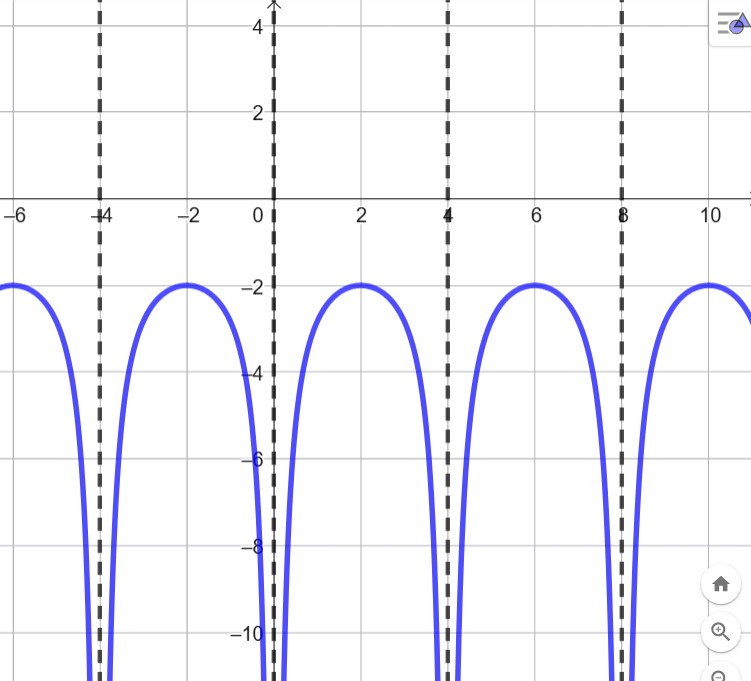
The graph of a function \(f\) is shown in FigureΒ 238. Which of the following do you expect to be true regarding \(f'\) and \(f''\) ?
Periodic graph with repeating downward arches, vertical dashed asymptotes at x = βˆ’4, 0, 4, and 8, and local maxima at y = βˆ’2 midway between the asymptotes.
Figure 238. The graph of function \(f\text{.}\)
  • \(f'(x)\) will be periodic.
  • Correct.
  • \(f'(x)\) will be continuous.
  • The graph of \(f'(x)\) will lie entirely above the \(x\) -axis.
  • \(f'(x)\) will be increasing on its domain.
  • \(f'(2k)=0\) for all integers \(k\) .
  • \(f'(-\pi) = -f'(\pi)\)
  • Correct.
  • \(f'\) has no \(x\) -intercepts.
  • \(f'\) has no vertical asymptotes.
  • The graph of \(f''(x)\) will lie entirely below the \(x\) -axis.
  • Correct.
  • \(f''(x)\) will be periodic.
  • Correct.

8.

Evaluate the derivatives of the following functions:
  1. \(\displaystyle f(x) = 6\sqrt{x}+ 4\csc(x)\)
  2. \(\displaystyle g(x) = e^{2} + 2^{4x^2-x}\)
  3. \(\displaystyle \displaystyle p(x) = \lim_{h \rightarrow 0}\frac{(x+h)^{7} - x^{7}}{h}\)
Answer.
  1. \(\displaystyle \displaystyle f'(x) = 3x^{-1/2} - 4\csc(x)\cot(x)\)
  2. \(\displaystyle g'(x) = 0 + (8x-1)2^{4x^2-x}\ln(2)\)
  3. This is the definition of \(p'(x)\) for a function \(x^7\text{.}\) That is, \(p(x)=7x^6\text{.}\) So, \(p'(x) = 42x^5\text{.}\)