Handout Exam 1 - Fall 2024

Section Topics

1.1-1.7
Be sure to try each question before looking at the solutions.

Exercises Questions

1.

An object’s height above the ground is recorded at various times. TableΒ 222 gives the object’s height \(s(t)\) (measured in meters) at time \(t\) (measured in seconds).
Table 222. An object’s height \(s(t)\) measured at various times \(t\text{.}\)
  1. Calculate the average velocity \(AV_{[1,3]}\) of the object between times \(t=1\) and \(t=3\) seconds.
  2. Calculate the average velocity \(AV_{[3,5]}\) of the object between times \(t=3\) and \(t=5\) seconds.
  3. Using a central difference, estimate the value of \(s'(3)\) . Be sure to include units. Then, use a sentence to explain the meaning of this value in this context.
  4. Do you think \(s''(t)\) is positive, negative, or zero on \((0,5)\) ? Why?
Answer.
  1. \(AV_{[1,3]} = \frac{8-24}{3-1} = -8\) meters per second
  2. \(AV_{[3,5]} = \frac{0-8}{5-3} = -4\) meters per second
  3. \(s'(3) \approx \frac{s(4)-s(2)}{4-2} = \frac{3-15}{2} = -6\) meters per second. This estimates the instantaneous velocity of the object at time \(t=3\) seconds.
  4. \(s'(t)\) is increasing (becoming less negative) so \(s''(t)\) is positive.

2.

The height \(h(V)\) (measured in meters) of a given volume \(V\) of water in a tank (measured in liters) is measured as the tank is filled.
  1. What are the units of the derivative \(h'(V)\) ?
  2. The value \(h'(V)\) is always positive. Why?
  3. Carefully sketch a diagram illustrating the shape of a tank for which \(h''(V) =0\) .
Answer.
  1. meters per liter
  2. As the volume \(V\) increases, so does the height \(h(V)\) of water in the tank. So \(h(V)\) is increasing.
  3. The sides of the tank should be vertical so that the rate at which the height increases with respect to volume remains constant. A cylinder works for this.
    Figure 223. A cylinder with circular top and bottom faces and vertical sides.

3.

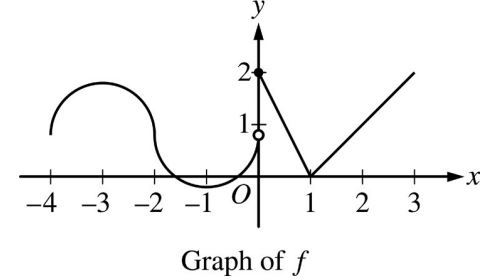
The graph of the piecewise-defined function \(f\) is shown in FigureΒ 224. The graph has a vertical tangent line at \(x=-2\) and horizontal tangent lines at \(x=-3\) and \(x=-1\) . What are all values of \(x\) , \(-4 < x < 3\) at which \(f\) is continuous but not differentiable?
Graph of a piecewise function with a curved segment from x approximately equal to -4 to x = 0 ending at an open circle near (0, 1), a filled point at (0, 2), a line segment descending to (1, 0), and a line segment rising from (1, 0) to the right.
Figure 224. Where is \(f\) continuous but not differentiable?
  • \(x=-2\) and \(x=1\)
  • Correct. Note the vertical tangent at \(x=-2\) and the cusp at \(x=1\text{.}\)
  • \(x=1\)
  • \(x=-2\) and \(x=0\)
  • \(x=0\) and \(x=1\)

4.

Consider the function
\begin{equation*} f(x) = \begin{cases}2x-2\amp \text{if }x < 3\\ 2x-4 \amp \text{if }x \geq 3.\end{cases} \end{equation*}
Let \(f\) be the piecewise-linear function defined above. Which of the following statements are true?
  1. \(\displaystyle \displaystyle \lim_{h \rightarrow 0^-}\frac{f(3+h)-f(3)}{h}=2\)
  2. \(\displaystyle \displaystyle \lim_{h \rightarrow 0^+}\frac{f(3+h)-f(3)}{h}=2\)
  3. \(\displaystyle \displaystyle f'(3)=2\)
  • II only
  • Correct. Note that
    \begin{align*} \frac{f(3+h)-f(3)}{h} \mathstrut \amp = \frac{2(3+h)-2-[2(3)-4]}{h} \\ \amp = \frac{2h+2}{h} \text{ for } h < 0 \end{align*}
  • None of these statements are true.
  • I and II only
  • I, II, and III

5.

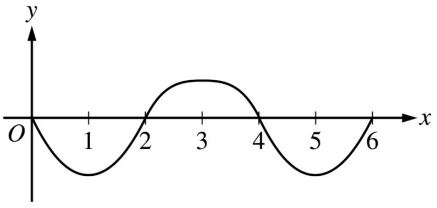
On which interval(s) is \(f(x)\) increasing based on the graph of \(f'(x)\)shown in FigureΒ 225?
Graph of a smooth wave-like curve crossing the x-axis at x = 0, 2, 4, and 6, with a local minimum near x = 1, a local maximum near x = 3, and another local minimum near x = 5.
Figure 225. Where is \(f\) increasing? This is the graph of \(f'\text{.}\)
  • \((2,4)\)
  • Correct. This is where \(f'\) is above the horizontal axis.
  • \((1,3) \cup (5,6)\)
  • \((0,3)\)
  • \((0,2) \cup (4,6)\)

6.

Evaluate the following limit:
\begin{equation*} \lim_{x \rightarrow 4}\frac{x^{2}-8x+16}{x-4} \end{equation*}
  • \(0\)
  • Correct. \(\displaystyle \lim_{x \rightarrow 4} \frac{(x-4)(x-4)}{x-4} = \lim_{x \rightarrow 4} x-4 = 0\)
  • \(8\)
  • \(-8\)
  • \(\infty\)
  • Does not exist

7.

If \(f(x) = 2+|x-3|\) for all \(x\) , then the value of \(f'(2)\) is
  • \(-1\)
  • Correct. Graph this function and look at the slope at \(x=2\text{.}\)
  • \(0\)
  • \(1\)
  • \(2\)
  • nonexistent

8.

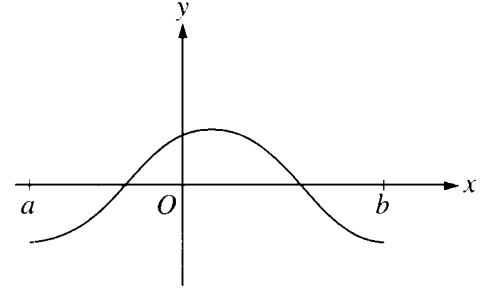
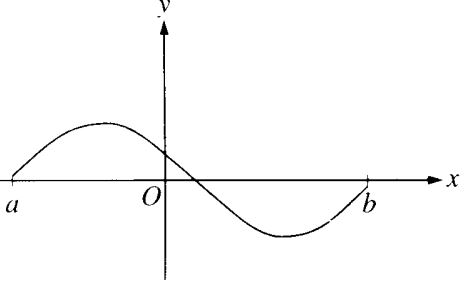
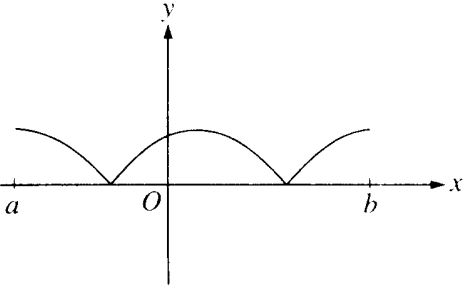
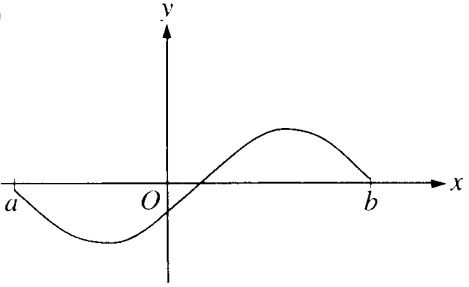
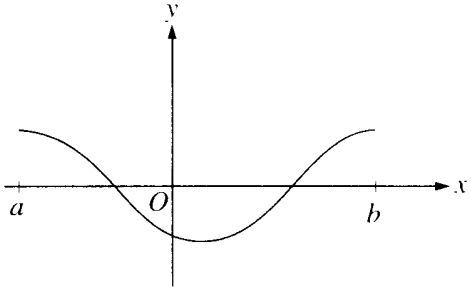
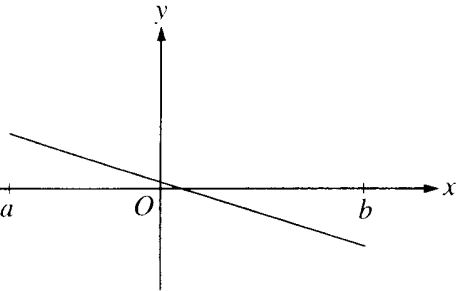
The graph of \(f\) is shown in FigureΒ 226. Which of the following could be the graph of \(f'\) ?
Graph of a smooth curve rising from below the x-axis, crossing the x-axis left of the y-axis, reaching a maximum above the axis near the y-axis, then crossing the x-axis again before descending below the axis toward b.
Figure 226. The graph of \(f\text{.}\)
  • Graph of a smooth curve starting at the x-axis at a, rising to a hump above the axis, crossing the x-axis just to the right of the y-axis, dipping to a valley below the axis, and returning to the x-axis at b.
  • Correct.
  • Graph of three connected arch-shaped curves above the x-axis, touching the x-axis at two sharp points and remaining nonnegative between a and b.
  • Graph crossing the x-axis at aaa, dipping below the axis to a minimum left of the y-axis, crossing upward through the origin region, rising to a hump above the axis, and returning to the x-axis at b.
  • Graph of a smooth curve crossing the x-axis twice, dipping to a minimum below the axis near the y-axis, and rising above the axis toward both endpoints a and b.
  • Graph of a decreasing straight line crossing the x-axis near the y-axis, with positive values on the left and negative values on the right between a and b.

9.

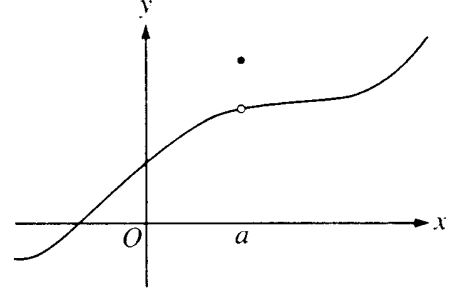
The graph of a function \(f\) is shown in FigureΒ 227. Which of the following statements about \(f\) is false? [More than one statement might be false.]

Graph of an increasing curve with a hole at x=a on the curve and a filled point directly above it.
Figure 227. The graph of \(f\text{.}\)
  • \(f\) is continuous at \(x=a\)
  • Correct. The limit at one point is not the same as the functional value.
  • \(x=a\) is in the domain of \(f\)
  • \(\displaystyle \lim_{x \rightarrow a^+}f(x) = \lim_{x \rightarrow a^-}f(x)\)
  • \(\displaystyle \lim_{x \rightarrow a}f(x)\) exists

10.

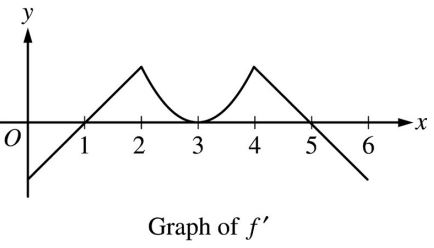
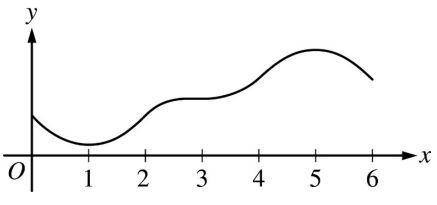
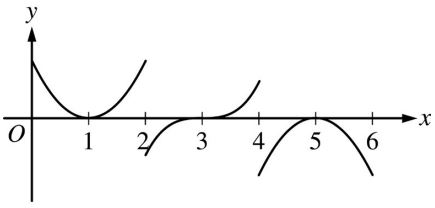
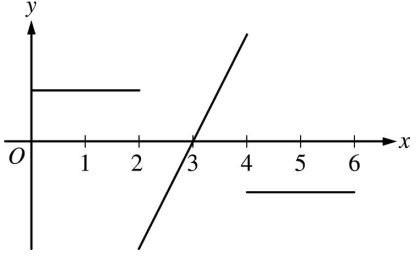
The graph of \(f' \text{,}\) the derivative of the function \(f\text{,}\) is shown in FigureΒ 228. Which of the following could be the graph of \(f\) ?
Graph of f’ consisting of two line segments and two curved arches above the x-axis, crossing the x-axis at x=1 and x=5, touching the x-axis at x=3, with peaks near x=2 and x=4.
Figure 228. The graph of \(f'\text{.}\)
  • Graph of a smooth curve that decreases to a local minimum near x=1, then rises with a brief flat region near x=3, reaches a local maximum near x=5, and decreases afterward.
  • Correct.
  • Graph of a smooth wave-like curve crossing the x-axis at x=0, x=2, x=4, and x=6, with minima near x=1 and x=5 and a maximum near x=3.
  • Graph with three separate curve segments: an upward-opening curve tangent to the x-axis at x=1, a second upward-opening curve tangent to the x-axis at x=3, and a downward-opening curve tangent to the x-axis at x=5.
  • Graph with three disconnected pieces: a horizontal segment above the x-axis from x=0 to x=2, an increasing line segment crossing the x-axis at x=3, and a horizontal segment below the x-axis from x=4 to x=6.

11.

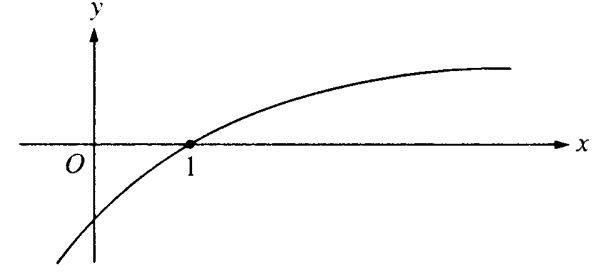
The graph of a twice-differentiable function \(f\) is shown in FigureΒ 229. Which of the following is true?
Graph of a curve increasing from below the x-axis, crossing the x-axis at the filled point (1, 0), then continuing upward and leveling off as x increases.
Figure 229. The graph of twice-differentiable \(f\text{.}\)
  • \(f''(1)<f(1)<f'(1)\)
  • Correct. The concavity is negative; the value is zero, and the slope is positive.
  • \(f(1)<f'(1)<f''(1)\)
  • \(f'(1)<f(1)<f''(1)\)
  • \(f(1)<f''(1)<f'(1)\)
  • \(f''(1)<f'(1)<f(1)\)