Handout Exam 1 - Fall 2025

Section Topics

1.1-1.7
Be sure to try each question before looking at the solutions.

Exercises Questions

1.

Scientists are monitoring ground elevation near a volcano to detect signs of potential eruption. The elevation \(h(t)\) , in meters, is measured at regular intervals of time \(t\) , in days.
Table 212. Ground elevation near a volcano.
\(t\) (days)
\(h\) (m)
1200.0
1200.8
1201.7
1202.5
1203.0
  1. Estimate \(h'(6)\) using a central difference. Be sure to include units on your response.
  2. Does \(h''(6)\) appear to be positive or negative? Explain.
  3. What are the units on \(h''(6)\) ? In words, interpret the meaning of the value of \(h''(6)\) .
Answer.
  1. \(h'(6) \approx \frac{1203.0-1201.7}{8-4} = 0.325\) meters per day
  2. \(h''(6)\) appears to be negative since the rate of increase of \(h\) seems to be decreasing at \(t=6\) days.
  3. \(\frac{\frac{meters}{day}}{day}\text{;}\) this is the rate at which the rate of height increase each day, increases
2.

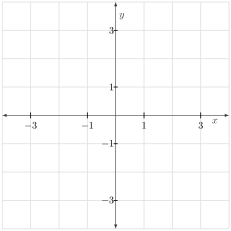
On FigureΒ 213 draw the graph of a function \(f(x)\) for which
  1. \(f(-2)<0\text{,}\)
  2. \(f'(-2)<0\text{,}\)
  3. \(f''(-2)=0\text{,}\) and
  4. the average rate of change of \(f\) on the interval \([-2,1]\) is zero.
Clearly label values of points on the graph at \(x=-2\) and \(x=1\text{.}\)
An empty coordinate axes system.
Figure 213. Graph a function \(f(x)\) meeting the required conditions.
Answer.
Answers will vary. However, they all will have the same \(y\)-coordinate at \(x=2\) and \(x=1\text{.}\) And, they will be below the \(x\)-axis, decreasing, and likely changing concavity at \(x=2\text{.}\)

3.

The temperature \(T\) (measured in \(^{\circ}F\) ) of a cup of coffee at time \(t\) minutes after it is poured into a coffee cup is given by
\begin{equation*} T(t) = A + Be^{-ct} \end{equation*}
where \(A>0\) , \(B>0\) , and \(c>0\) are constants.
  1. What are the units of \(A\) and \(B\) ?
  2. What are the units of \(c\) ?
  3. What are the units of \(T'(t)\) ? In words, what does the value \(T'(10)\) represent?
  4. Do you expect \(T''(10)\) to be positive, negative, or zero? Why?
Answer.
  1. \(\displaystyle ^{\circ}F\)
  2. per minute
  3. \(\frac{^{\circ}F}{minute}\text{;}\) \(T'(10)\) represents the rate at which the coffee increases in temperature 10 minutes after it is poured.
  4. \(T''(10)>0\) since the graph of \(T(t)\) is decreasing but concave up.

4.

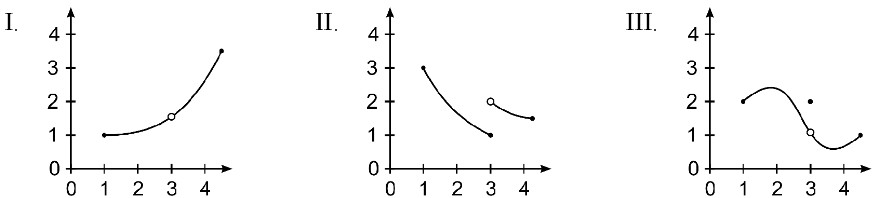
For which of the graphs shown in FigureΒ 214 does \(\displaystyle \lim_{x \rightarrow 3}f(x)\) exist?
Three graphs labeled I, II, and III, each showing behavior near x = 3. I. An increasing curve with a hole at x = 3 and y about 1.5. The curve approaches the hole from both sides. II. Two separate curve pieces. As x approaches 3 from the left, the graph approaches y about 1; as x approaches 3 from the right, the graph approaches y about 2. III. A smooth curve with a hole at (3, 1) and a filled point at (3, 2). The curve approaches y = 1 from both sides, but the function value at x = 3 is 2.
Figure 214. Where does \(\displaystyle \lim_{x \rightarrow 3}f(x)\) exist?
  • I
  • Correct.
  • II
  • III

5.

The derivative of some function \(f\) at some location \(x=a\) is given by the value of
\begin{equation*} \lim_{h \rightarrow 0}\frac{e^{-1-h}-e^{-1}}{h}. \end{equation*}
Identify \(f(x)\) and the value of \(a\) .
Answer.
\(f(x)=e^{-x}\) and \(a=1\)

6.

A line through the point \((2,-2)\) is tangent to function \(f\) at the point \((-2,6)\) . What is \(f'(-2)\) ?
  • \(-2\)
  • Correct.
  • \(-8\)
  • \(-\frac{1}{2}\)
  • \(6\)
  • Undefined

7.

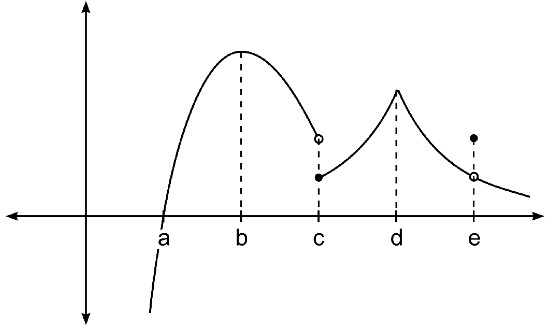
Shown in FigureΒ 215 is a graph of function \(f\) . At which value of \(x\) is \(f\) continuous but not differentiable?
Graph with labeled points a, b, c, d, and e. The curve has a smooth maximum at b, a hole and separate filled point at c, a sharp peak at d, and a hole with a different function value at e.
Figure 215. Where is \(f\) continuous but not differentiable?
  • a
  • b
  • c
  • d
  • Correct.
  • e

8.

[Yes, this involves the absolute value!] Suppose that
\begin{equation*} f(x) = \left| -x^{2}+2x+3\right|. \end{equation*}
Use the limit definition of derivative to find the value of the derivative \(f'(2)\) . Be sure to use appropriate limit notation. Solutions using other methods will not receive credit.
Answer.
\(\displaystyle f'(2) = \lim_{h \rightarrow 0} \frac{f(2+h)-f(2)}{h}\) where \(f(2)=|(-2)^2 + 2(2)+3| = 3\text{.}\) So, we have
\begin{align*} f'(2) \mathstrut \amp = \lim_{h \rightarrow 0} \frac{ |-(2+h)^2 + 2(2+h)+3| - 3}{h} \\ \amp = \lim_{h \rightarrow 0} \frac{ -(2+h)^2 + 2(2+h)+3 - 3}{h} \end{align*}
since \(-(2+h)^2 + 2(2+h)+3 \approx 3 > 0\) for \(h\) small. So,
\begin{align*} f'(2) \mathstrut \amp = \lim_{h \rightarrow 0} \frac{-4 - 4h - h^2 + 4 + 2h + 3 -3}{h} \\ \amp = \lim_{h \rightarrow 0} \frac{h(-2-h)}{h} \\ \amp = -2 - h \\ \amp = -2 \end{align*}

9.

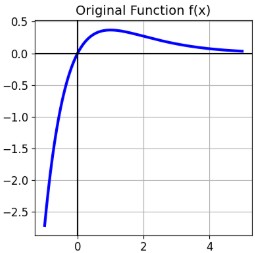
In FigureΒ 216 is the graph of \(f(x)\) .
Graph of a curve that rises rapidly from below the x-axis, reaches a maximum near x = 1, then gradually decreases while remaining above the x-axis.
Figure 216. Which is a possible graph of \(f'(x)\text{?}\)
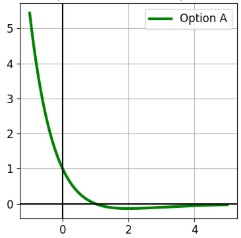
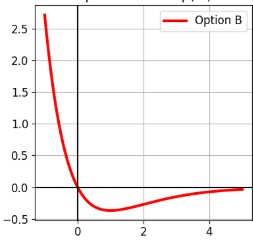
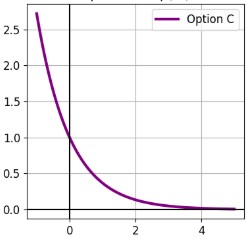
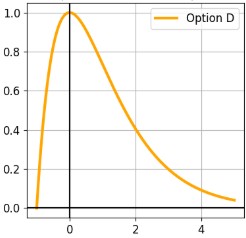
Which of the following is a possible graph of \(f'(x)\) ?
  • Graph of a curve that decreases steeply, crosses the x-axis, reaches a shallow minimum, and then rises gradually toward zero.
    Figure 217. Option A
  • Correct.
  • Graph of a curve that decreases rapidly, crosses the x-axis near x = 0, reaches a minimum, and then slowly rises toward zero.
    Figure 218. Option B
  • Graph of a decreasing curve that remains above the x-axis and approaches zero as x increases.
    Figure 219. Option C
  • Graph of a curve that rises to a maximum near x = 0, then decreases while remaining above the x-axis.
    Figure 220. Option D
  • None of these. It looks like...

10.

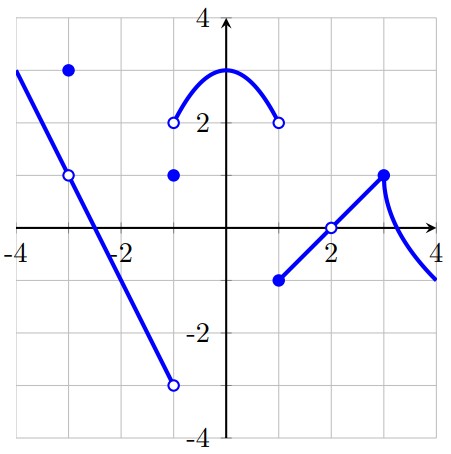
For the graph of \(y=f(x)\) given in FigureΒ 221, find all values of \(a\) in the interval \((-4,4)\) for which \(\displaystyle \lim_{x \rightarrow a}f(x)\) does not exist.
Graph with several pieces, including a decreasing line, an upper arc, an increasing line segment, and a decreasing curve. Open and closed circles indicate holes and defined function values at several x-values.
Figure 221. For which \(a\) values does \(\displaystyle \lim_{x \rightarrow a}f(x)\) not exist?
Answer.
\(a=-1,1\)

11.

A scientist measures the temperature \(T\) (measured in kelvins) of a certain metal bar \(t\) seconds after heat is removed. The equation
\begin{equation*} \displaystyle T(t)=\frac{30}{e^{t}}+ 10e^{t} \end{equation*}
models the data observed.
The scientist also observes that the length \(L\) of the metal bar (measured in centimeters) depends on its temperature through the equation
\begin{equation*} \displaystyle L(T) = 0.01T^{3} + \frac{64000}{T}. \end{equation*}
  1. Explain the meaning of \(T'(300)\) in the context of this problem. Be sure to include units.
  2. Describe as precisely and specifically as you can what the quantity \(\displaystyle Q=\frac{T(273)-T(152)}{121}\) represents in the context of this problem.
  3. Do you expect \(L'(400)\) to be positive or negative? Why? What are the units for this value and what does the value of \(L'(400)\) physically represent?
Answer.
  1. \(T'(300)\) gives the rate at which the temperature of the bar increases (in Kelvin per second) 300 seconds after the heat is removed.
  2. This is the average rate of change of the temperature of the bar between times 152 and 273 seconds (measured in Kelvin per second).
  3. I expect \(L'(400)\) to be positive since the length of bar should increase as it gets warmer. Units are centimeters per Kelvin. \(L'(400)\) represents the rate at which length of bar increases due to change in temperature at the instant the temperature of the bar is 400 Kelvin.