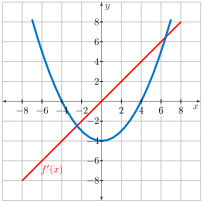
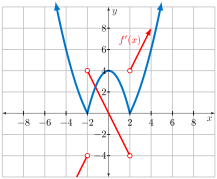
We have recently learned that we can describe the instantaneous rate of change of a function \(f\) at a value \(a\) by computing \(\displaystyle f'(a)=\lim_{h\rightarrow 0}\frac{f(a+h)-f(a)}{h}\text{,}\) provided this limit exists. When we can find \(f'(a)\text{,}\) we understand that this value represents the instantaneous rate of change of the function with respect to the input variable, and also the slope of the tangent line to the curve \(y=f(x)\) at the point \((a,f(a))\text{.}\)
By viewing the constant \(a\) as a variable in its own right, we will next begin thinking about how \(y=f'(x)\) is itself a function, indeed a function that is related to - or derived from - the original function \(f\text{.}\) One of the next big questions is: given a function \(y=f(x)\text{,}\) can we find a graph of or formula for or other information about this new function \(f'(x)\text{?}\)
The section covers the following topics: The derivative as a function. The relationship between the graph of \(f\) and the graph of \(f'\text{.}\) Computing the derivative function of basic functions using the definition of the derivative.
These are the tasks you should be able to perform with reasonable fluency when you arrive at our next class meeting. Important new vocabulary words are indicated in italics.
📝 [Submit] Explore the two applets mentioned in the text. The first applet, Graphing the derivative function is intended to experiment with moving the red point. For the second applet, The Derivative as a Function, answer the Explore questions found on the website. Submit a screen capture of the second applet, The Derivative as a Function as well as answers to the Explore questions found on the website.
Ask Copilot to produce an algorithm for you to calculate the derivative function \(f'(x)\) for a function \(f(x)\) using the limit definition. Follow up by asking Copilot to illustrate how this algorithm works on \(f(x) = \sqrt{x}\text{.}\) Finally, ask why the numerator was rationalized. Tell it that you feel like that is some sort of odd trick.
📝 [Submit] Ask Copilot for alternate versions of the limit definition of the derivative of a function \(f(x)\text{.}\) Submit at least one alternate, but equivalent to found in our textbook, version of the definition of \(f'(x)\) that uses a limit.
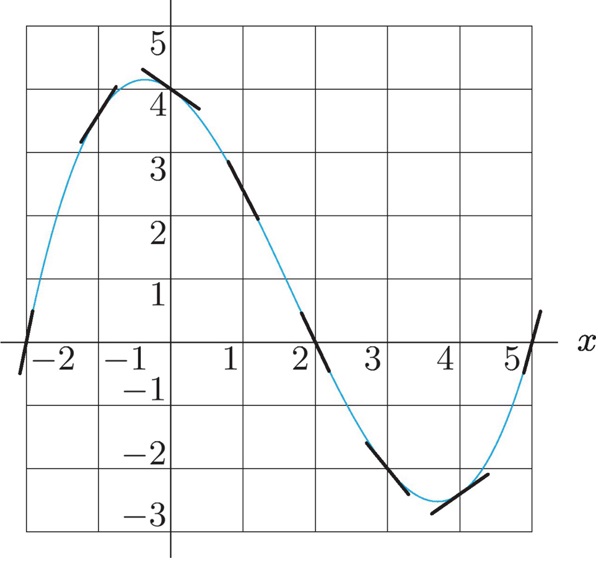
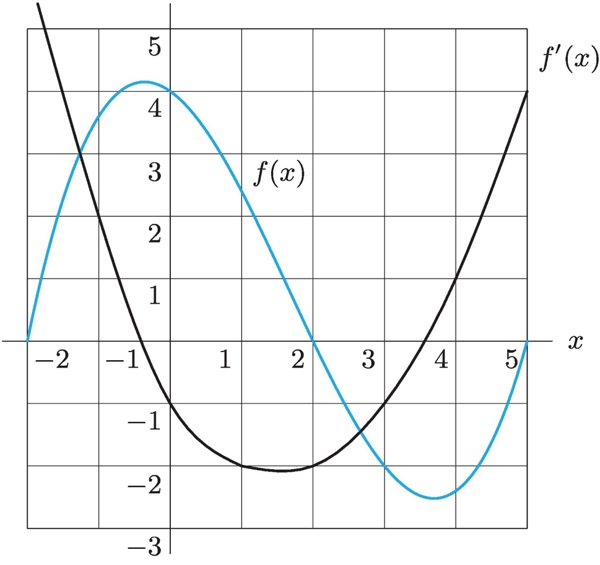
Complete the table below with estimated values of the derivative of the function \(f(x)\) shown. Then, plot these ordered pairs \((x,f'(x))\) from the table on the same set of axes. ‘Connect the dots’ to form a sketch of the graph of \(f'\text{.}\)
Explore this applets that gives you practice identifying the graph of the derivative knowing the graph of a function: Identify the Derivative Function.
Explore graph transformations with this applet: Derivatives and Graph Transformations. Make sure you write answers to the questions asked of you. This is a great applet and well worth your time exploring!
Given a graph of a function \(f\text{,}\) identify the graph of its derivative \(f'\) from a list, and describe aspects of the behavior of the graph of \(f'\text{.}\)
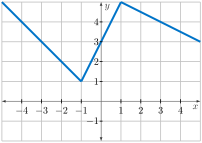
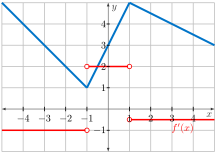
\(\displaystyle \lim_{h \rightarrow 0^-}\frac{f(1+h)-f(1)}{h}= 2\) while \(\displaystyle \lim_{h \rightarrow 0^+}\frac{f(1+h)-f(1)}{h}= -\frac{1}{2}\text{.}\) This tells us that \(f'(1)\) does not exist.