Up next in our discussions is the definition of the foundational idea of nearly all first semester calculus: the derivative of a function at a point. As you will see soon, the derivative relies upon the ideas of average rate of change and limits. Indeed, the derivative is all about change that is happening instantaneously, and that instantaneous rate is the limit of corresponding average rates. One especially important note at the outset: the definition of the derivative is notationally complicated. As you read and study, pay close attention to the notation used in the definition of the derivative, and strive to not only know that notation by heart, but to make sense of it for yourself.
This section covers the following concepts: Average and instantaneous rate of change. Definition of the derivative at a point. Differentiability. Units of the derivative. Slope of the tangent line.
These are the tasks you should be able to perform with reasonable fluency when you arrive at our next class meeting. Important new vocabulary words are indicated in italics.
State the definition of average rate of change and the definition of instantaneous rate of change of a function \(f\text{.}\) Explain the difference between these two quantities.
📝 [Submit] Explore the applet: Investigating the Derivative of a Function at a Point. Then, explain what the value of \(m\) in the applet represents. How can the applet be used to estimate the value of \(f'(3)\text{?}\) What is the approximate value of \(f'(3)\text{?}\)
Use the applet to determine what happens to these secant lines as \(h \rightarrow 0\text{.}\) This unique line is called the tangent line. What is the apparent slope of this tangent line?
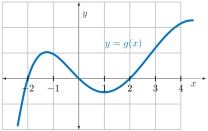
Use the applet to determine what happens to secant lines through \((0,g(0))\) and \((h,g(h))\) as \(h \rightarrow 0\text{.}\) Form a hypothesis about the slope of the tangent line to \(g(x)\) at \(x=0\text{.}\)
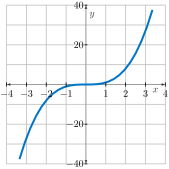
Re-read Example 1.3.8. Then, determine the equation of the tangent line to \(y=x^{3}\) at \(x=2\text{.}\) Sketch this tangent line on the curve to verify its reasonableness.
Explore the following interactive applet by Marc Renault (make sure to follow the instructions listed under “Explore”): Applet: The Derivative at a Point
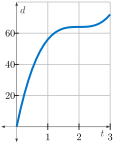
A car is traveling down a highway away from its starting location with distance function \(\displaystyle d(t) = 8(t^{3} - 6t^{2} + 12t)\) where \(t\) is in hours and \(d\) is in miles.
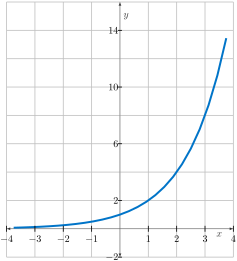
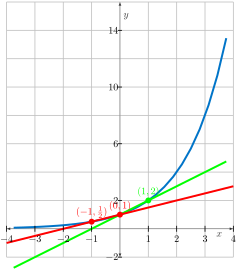
As \(h\) approaches 0, we would guess that the slope of the tangent line approaches \(\ln 2 \approx 0.69\text{.}\) [Later, we will see it is exactly \(\ln 2\text{.}\) For now, we estimate 0.7 or so.]
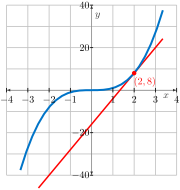
The equation of the tangent line to \(y=x^{3}\) at \(x=2\) is \(y=12x-16\text{.}\) A sketch of this tangent line on the curve is shown in Figure 27 in red. To find this line, note that the slope of this line is \(\displaystyle \lim_{h \rightarrow 0}\frac{(2+h)^{3}-2^{3}}{h}= 12\text{.}\) Then, recognize that \((2,8)\) is a point on the line so that \(y-8 = 12(x-2)\) represents the line.