In several different contexts, we will see that it is useful to consider a function that is described implicitly, rather than explicitly. A prominent simple example is that of a circle: while no single function of the form \(y=f(x)\) can represent every point on the circle, there is nonetheless a key relationship between the \(x\) and \(y\) coordinates of points on the curve. In more complicated settings, we’ll see that while there is a relationship between \(x\) and \(y\text{,}\) there is no way to explicitly solve for \(y\) in terms of \(x\text{.}\) In this setting and others similar to it, we want to be able to still compute \(\displaystyle \frac{dy}{dx}\text{.}\) The process of implicit differentiation enables us to do so.
These are the tasks you should be able to perform with reasonable fluency when you arrive at our next class meeting. Important new vocabulary words are indicated in italics.
(Review) Given a basic differentiation rule, gives its chain rule version. For example, the chain rule version of \(\frac{d}{dx}[x^{n}] = nx^{n-1}\) is:
State an example of a function that is defined explicitly by a relation between \(x\) and \(y\text{,}\) and give an example where the relation is implicit.
Enter Derivative(\(x^{2}\cdot f(x)\)) in the next input box. Does the result match what you expected based on your answer to (b) in Preview Activity 2.7.1?
Change the function defined in the first input box from sin(x) to \(2^{x}\). Again, does the result match what you expected based on your answer to (b) in Preview Activity 2.7.1?
Prompt Copilot “Walk me through an example of computing \(dy/dx\) for an equation in which \(y\) is defined by \(x\) implicitly. The graph of the equation should have 2 or more slopes at the \(x\)-value chosen to compute \(dy/dx\) at.”
📝 [Submit] Do write a short explanation of the difference between writing \(\frac{d}{dx}[x^{2} + y^{2}]\) and \(\frac{dy}{dx}[x^{2} + y^{2}]\text{.}\) That is, explain the big difference between the meanings of the symbols \(\frac{d}{dx}\) and \(\frac{dy}{dx}\text{.}\)
Many mistakes in implicit differentiation occur when differentiating expressions that contain \(y\text{.}\) For each expression, match it with its correct derivative with respect to \(x\text{.}\)
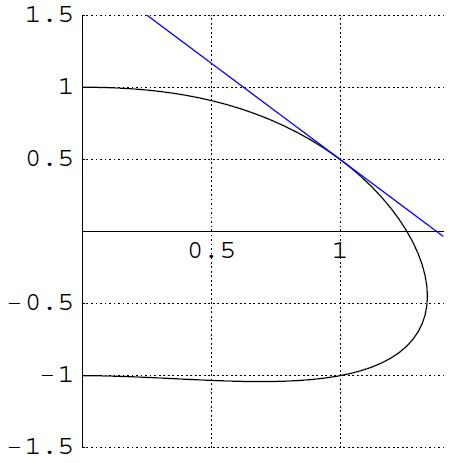
Find the equation of the tangent line to the curve \(x^{3}+x^{2}y+2y^{2}=2\) at the point \((1,0.5)\text{.}\) Your tangent line should match that shown on the diagram in Figure 73.
Explore an applet Implicit Differentiation that will make you the world champion of understanding how to use implicit differentiation on circles, ellipses, and hyperbolae. As always, do the three ‘explore’ questions to fully benefit from the activity. If you can survive the challenge, you probably no longer need to study this topic!
Given an implicitly defined curve and a point on the curve, find the local linearization at this point to approximate the coordinates of nearby points.
Understand how to use \(\frac{dy}{dx}\) (which may depend on both \(x\) and \(y\)) to determine all points where the tangent line to a given implicit curve is horizontal or vertical.