We have come a long way in just over a week’s time: from the initial basic rules for power and exponential functions, to the structure rules given by the sum and constant multiple rules, then the basic rules for the sine and cosine functions, followed by the more complicated structure rules given by the product and quotient rules. With those rules in hand, we have found derivatives for the remaining trigonometric functions, and we are now ready to deal with one more way that functions can be combined: composite functions, also known as chains of functions. The derivative rule which helps us deal with these is called the Chain Rule.
These are the tasks you should be able to perform with reasonable fluency when you arrive at our next class meeting. Important new vocabulary words are indicated in italics.
Identify the “inner” and ‘outer” function in a composite function of the form \(C(x) = f(g(x))\text{,}\) such as in \(C(x) = e^{x^2+1}\) or \(C(x) = \sqrt{\cos x + 4}\text{.}\)
Ask Copilot “Explain, in the simplest of terms, why the chain rule formula in calculus is the way it is. Be sure that I see the chain of variables that is involved. Maybe focus on a food chain for me.” Submit two sentences summarizing the idea returned by the AI.
Imagine we are moving straight upward in a hot air balloon. Let \(y\) be our distance from the ground. The temperature, \(H\text{,}\) is changing as a function of altitude, so \(H = f(y)\text{.}\) In fact, it decreases at a rate of \(16^{\circ}F\) per mile. Meanwhile, our balloon is climbing at a rate of 2 miles per hour (mph). How much does our temperature change during our first 15 minutes?
In the previous problem, temperature is a function of height, \(H = f(y)\text{,}\) and height is a function of time, \(y=g(t)\text{.}\) So, we can think of temperature as a composite function of time, \(H=f(g(t))\) ,with \(f\) as the outside function and \(g\) as the inside function. For the functions below, identify a composite function \(C(t)\) by describing an outside function \(f\) and an inside function \(g\text{.}\)
The length \(C\) (in micrometers) of steel depends on the air temperature (in \(^{\circ}C\)), and the temperature depends on time, \(t\text{,}\) measured in hours. The length of a steel bridge increases by 0.2 micrometers for every degree increase in temperature (and is 1 micrometer at temperature of \(0^{\circ}C\)). The temperature is increasing at \(3^{\circ}C\) per hour and is \(4^{\circ}C\) at time \(t=0\) hours.
📝 [Submit] Do the following construction in GeoGebra that may help convince you of the accuracy of the chain rule. Submit screenshots and answers to the questions posed as needed.
In the third input box, we define the composite function \(h(x)=f(g(x))\text{.}\) To do so, simply type f(g(x)). GeoGebra should output \(\sqrt{2x+3}\text{.}\)
We will now pick a point on the graph of \(h\) to measure the slope (i.e. the derivative of \(h\)). In the next input box, type A = (3, h(3)). GeoGebra will plot the point \(A\) at \((3,3)\text{.}\) On the fourth button (see Figure 60), choose the Tangents option. Then, click on point A on your graph followed by clicking on the graph (of \(h\)) itself. This will produce a tangent line to your function \(h\) at \((3,3)\text{.}\) It will name this tangent line and an expression for it will appear in the next input box. From this tangent line equation, the value of \(h'(3)\) should be obvious. What is it?
Now we verify that \(h'(3) = f'(g(3))\cdot g'(3)\text{.}\) To that end, in the next input box type g’(3). GeoGebra should compute this value and name it \(a\text{.}\) Does the value returned make sense?
Repeat this process to compute \(f'(g(3))\) by typing f’(g(3)) in the next input box. GeoGebra will compute this value and name it \(b\text{.}\) In the final input box, type a * b. This should be the same as \(h'(3)\) (found earlier). Is it?
Each composite function can be viewed as an outside function acting on an inside function. Sort the cards so that each composite function is matched with a correct description of its inside and outside functions.
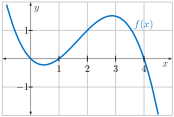
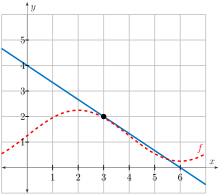
The graph of \(f(x)\) is given in Figure 62 It is known that \(f'(0)=-1\text{,}\)\(f'(1) = \frac{3}{4}\text{,}\)\(f'(2)=1\text{,}\) and \(f'(4) = -3\text{.}\) Define \(h(x) = f(x^{2})\text{.}\)
Prompt Copilot “Generate an example of a problem using a table where I would be asked to calculate the derivative of a composition of two functions using the chain rule. Be sure to also generate a solution for me.” Does the AI return a correct solution?
Differentiate functions that require the application of multiple rules. For instance, compute the derivative of \(\displaystyle g(x) = \frac{\sin^{2}(x) \cdot e^{x-5}}{\sqrt{x^{2}+1}}\text{.}\)
Explore the following applet (especially if you are mechanical engineering major(?): The intuitive notion of the chain rule. At first glance, the moving belts will make the chain rule jump out at you!
Watch video Chain rule \(u\)-notation (9:27). [If you would like more examples with the chain rule...one really can’t get enough - the chain rule is a crucial topic to your success.]
For each of the following functions of \(x\text{,}\) write the equation for the derivative function. Please do us both a favor and don’t simplify the answers.
\(\frac{dH}{dy}= -16\frac{^{\circ}F}{mi}\) and \(\frac{dy}{dt}= 2 \frac{mi}{hr}\) means that \(\frac{dH}{dt}= \frac{dH}{dy}\cdot \frac{dy}{dt}= (-16)(2) = -32 \frac{^{\circ}F}{hr}\text{.}\) In 15 minutes, \(H\) changes \(1/4\) of this or \(-8^{\circ}F\) (a decrease of 8 degrees Fahrenheit).
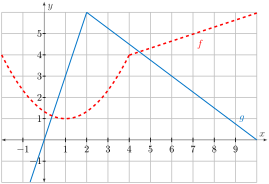
\(h'(x) = f'(g(x))g'(x)\) so that \(h'(1) = f'(g(1))g'(1) = f'(3)g'(1) = f'(3)\cdot 3 = \frac{2}{3}(2)(3) = 4\text{;}\) Note that on \((-2,4)\text{,}\) the function \(f(x)\) can be found to be \(f(x) = \frac{1}{3}(x-1)^{2} + 1\) by noting it has vertex at \((1,1)\) and the point \((4,4)\) determines \(c\) in \(f(x) = c(x-1)^{2} + 1\text{.}\)